
Written by Larissa Marques Pires Teixeira
Feature
Fishing is an activity that provides food and supports human livelihoods and has evolved over thousands of years alongside the development of societies. In the past, fishhooks were made from bone, and the first fishing nets emerged with the advent of early weaving techniques [1]. Today, fishing is a highly technological activity: fishers use phones to monitor tides, lunar phases, and weather conditions, while fishing gear has evolved from simple handlines to rods, reels, nets, and traps [1, 2].
Not all of this equipment makes it back to shore. Nets, fishing lines, traps, and other fishing gear can be lost at sea due to storms, accidents, broken lines, or improper disposal. This can have serious consequences for marine animals. Even without fishers nearby, lost fishing gear continues to do exactly what it was designed to do: catch marine life. Fish, sea turtles, sharks, rays, crustaceans, and even corals can become entangled for months or even years on the seafloor. This phenomenon is known as ghost fishing and represents one of the most silent and persistent human impacts on marine ecosystems, including coral reefs [3, 4].
Permanent traps for marine life
Every year, millions of tonnes of fishing gear are lost, abandoned, or discarded in the world’s oceans. Nets, longlines (main fishing lines carrying multiple baited hooks), traps, and ropes either drift freely or remain trapped on the seafloor. Collectively, these items are known as abandoned, lost, or otherwise discarded fishing gear (ALDFG). Because most of these materials are made from highly durable plastics, they can persist in the marine environment for decades or even centuries and directly affect marine life. Lines can entangle sharks, hooks get caught in fish, and debris can shade corals.
By surveying 84 coral ecosystems across 25 locations in the Pacific, Atlantic, and Indian Ocean basins, researchers found that macroplastics (plastic debris larger than 5 mm) accounted for 88% of all anthropogenic debris recorded. The primary source of plastic in most of these locations? Fishing activities (Figure 1) [4].
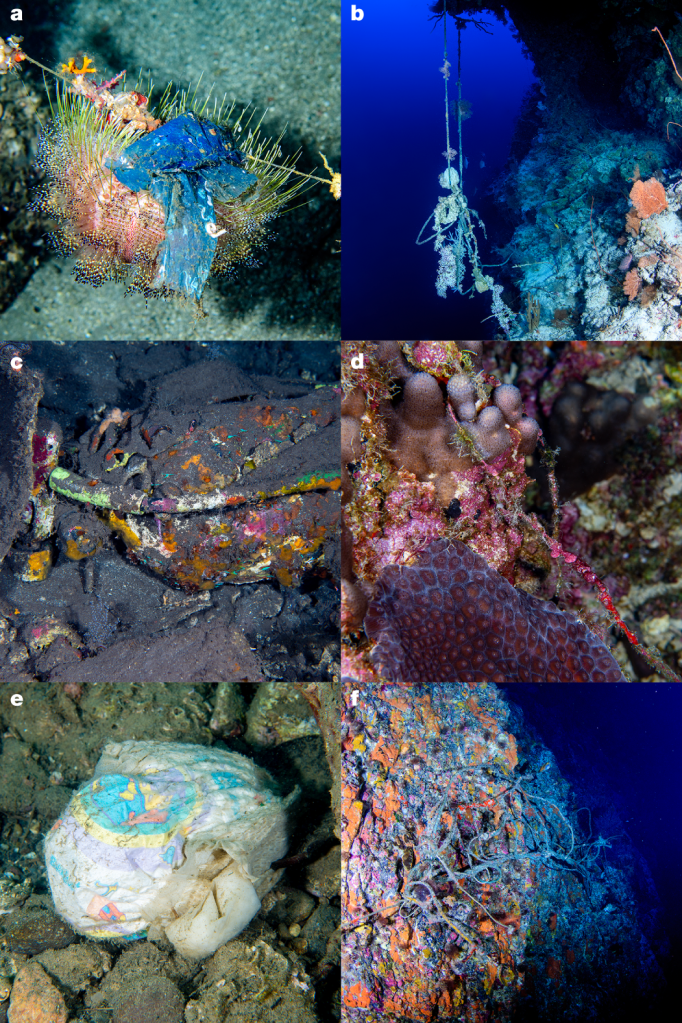
Figure 1: Different types of anthropogenic debris around the world, including abandoned, lost, or otherwise discarded fishing gear (ALDFG). (a) sea urchin, Asthenosoma varium, entangled with fishing line while camouflaging itself with a plastic bag at a depth of 130 m depth in the Philippines; (b) anchor line at 100 m depth in Palau; (c) diving cylinder and regulator at 105 m depth in Tahiti; (d) fishing line wrapped around coral at 45 m depth in Fernando de Noronha, Brazil; (e) a diaper at 40 m depth in the Philippines; and (f) fishing lines at 85 m depth in the São Paulo Archipelago, Brazil [4].
Coral reefs are among the ecosystems most vulnerable to ghost fishing. In addition to their extraordinary biodiversity, their complex three-dimensional structure makes it easy for fishing nets and lines to become snagged. Once entangled in coral colonies, these nets can remain in place for long periods, moving back and forth with waves and currents. This constant abrasion breaks coral colonies, strips away living tissue, and reduces the reef’s capacity to grow and recover [3].
Impacts that reach the deep reef
The same study also revealed another important finding that is often overlooked: the impact of ghost fishing on deeper coral reefs. According to the researchers, the greatest accumulation of fishing-related debris occurs in mesophotic coral ecosystems, which are deeper reefs found at approximately 30-150 meters, where sunlight is limited [4].
This high concentration of fishing debris on deep reefs may reflect changes in fishing effort along the depth gradient. As shallow ecosystems become less productive for sustaining fisheries, fishers may increasingly adapt their practices to exploit deeper coral reef habitats [4]. Unfortunately, fishing pressure is accompanied by an increase in discarded and lost fishing gear.
These ecosystems are vast and often poorly studied, but current research highlights the urgent need to include mesophotic coral reefs in marine management and conservation strategies. We can no longer assume that deep coral ecosystems are universally less vulnerable to human impacts or that they can serve as global refuges for threatened reef species [4].
The impacts extend far beyond corals
The effects of ghost fishing are not limited to corals. Reef fish, lobsters, octopuses, sea turtles, and many other marine organisms can become trapped in abandoned gear. Many die from drowning, starvation, or severe injuries. In some cases, the decomposition of trapped animals attracts scavengers—organisms that feed on dead and decomposing animals—and predators, which also become entangled, creating a continuous cycle of mortality [5]. This is precisely why these abandoned fishing gear are called “ghost gear”: they continue fishing long after they have been lost.
For example, sea turtle entanglement has been documented across all marine turtle species, life stages, and ocean basins, with evidence suggesting that juveniles living in the open ocean (pelagic juveniles) are particularly vulnerable. Alarmingly, a global review found that 91% of entangled turtles encountered by survey respondents were already dead when found [6].
Even when large pieces of debris do break down, they can cause even more problems as small particles. Over time, exposure to sunlight, wave action, and abrasion causes fishing gear to fragment into increasingly smaller particles, generating microplastics—plastic particles smaller than 5 mm—that can be ingested by a wide range of marine organisms [7]. These particles enter marine food webs and can affect organisms ranging from tiny invertebrates to top predators.
Prevention is far more effective than remediation
Unlike single-use plastics, for which more sustainable alternatives are increasingly available, replacing plastics used in fishing remains a significant challenge. Nets, ropes, and fishing lines are primarily manufactured from nylon and other synthetic plastics because of their low cost, high strength, and durability. Moreover, millions of people living in coastal communities rely on these materials for their livelihoods and food security. Addressing this issue will require the development of biodegradable materials capable of maintaining the performance of conventional fishing gear, as well as the inclusion of fishing gear in international policies and agreements aimed at reducing plastic pollution [4].
Several initiatives around the world are already working to reduce ghost fishing. The Global Ghost Gear Initiative (GGGI) brings together governments, universities, non-governmental organizations, fishing communities, and private companies to prevent, locate, and remove ALDFG from the marine environment [8]. Community engagement has also proven to be an effective strategy. Net Free Seas, an initiative led by the Environmental Justice Foundation (EJF), supports the collection and recycling of abandoned fishing gear by working with coastal communities and providing financial incentives for fishers and community members to recover, clean, and recycle these materials into new products [9].
Addressing ghost fishing requires a combination of prevention, recovery, and collaboration. Improved fishing gear management, including technologies that facilitate gear retrieval, together with regular underwater clean-up campaigns led by non-governmental organizations and volunteer dive teams, can help reduce the amount of abandoned gear in the ocean before it causes long-term harm to marine ecosystems [10, 11].
Ghost fishing reminds us that the impacts of human activities do not end when we leave the sea. A single lost piece of fishing gear can continue damaging marine ecosystems for many years, compromising habitats that took centuries to develop. At a time when coral reefs are already under increasing pressure from climate change, pollution, and invasive species [12], reducing fishing-related marine debris is a practical and effective action that benefits marine biodiversity as a whole.
References
Feature image from Scott 2023. https://doi.org/10.1038/s43017-023-00499-6.
- Gabriel, O., Lange, K., Dahm, E., & Wendt, T. (2005). Fish catching methods of the world (4th ed.). Blackwell Publishing Ltd.
- Gartside, D. F., & Kirkegaard, I. R. (2010). A history of fishing. In G. Lysenko, V. Squires, & W. H. Verheye (Eds.), Interactions: Food, Agriculture And Environment (Vol. 2). EOLSS Publications.
- Beneli, T. M., Pereira, P. H. C., Nunes, J. A. C. C., & Barros, F. (2020). Ghost fishing impacts on hydrocorals and associated reef fish assemblages. Marine Environmental Research, 161, 105129. https://doi.org/10.1016/j.marenvres.2020.105129
- Pinheiro, H. T., MacDonald, C., Santos, R. G., Ali, R., Bobat, A., Cresswell, B. J., Francini-Filho, R., Freitas, R., Galbraith G. F., Musembi P., Phelps, T. A., Quimbayo, J. P., Quiros, T. E. A. L., Shepherd, B., Stefanoudis, P. V., Talma, S., Teixeira, J. B., Woodall, L. C., Rocha, L. A. (2023). Plastic pollution on the world’s coral reefs. Nature, 619(7969), 311-316. https://doi.org/10.1038/s41586-023-06113-5
- Matsuoka, T., Nakashima, T., & Nagasawa, N. (2005). A review of ghost fishing: scientific approaches to evaluation and solutions. Fisheries Science, 71(4), 691-702. https://doi.org/10.1111/j.1444-2906.2005.01019.x
- Duncan, E. M., Botterell, Z. L., Broderick, A. C., Galloway, T. S., Lindeque, P. K., Nuno, A., & Godley, B. J. (2017). A global review of marine turtle entanglement in anthropogenic debris: a baseline for further action. Endangered Species Research, 34, 431-448. https://doi.org/10.3354/esr00865
- Ramos, S., Espincho, F., Rodrigues, S. M., Pereira, R., Silva, D., Rivoira, L., Perdigão, L., Almeida, C. M. R. (2025). An integrated approach to assessing the potential of plastic fishing gear to release microplastics. Water, 17(10), 1439. https://doi.org/10.3390/w17101439
- Global Ghost Gear Initiative. (2021). Best Practice Framework for the Management of Fishing Gear. Global Ghost Gear Initiative.
- Environmental Justice Foundation (EJF). 2023. Net Free Seas Handbook: For artisanal fishing communities. Environmental Justice Foundation. https://ejfoundation.org/resources/downloads/2022-Net-Free-handbook-EN-28Nov.pdf
- He, P., & Lansley, J. (2023). Voluntary Guidelines on the Marking of Fishing Gear. A framework for conducting a risk assessment for a system on the marking of fishing gear. Suppl. 1. FAO. https://doi.org/10.4060/cc4084en
- NOAA Marine Debris Program. 2015. Report on the impacts of “ghost fishing” via derelict fishing gear. Silver Spring, MD: NOAA Marine Debris Program. 25 pp. https://marine-debris-site-s3fs.s3.us-west-1.amazonaws.com/s3fs-public/publications-files/Ghostfishing_DFG.pdf?VersionId=slnn0koifEwCPJWiHO9zx5ictfntNjBB
- El-Naggar, H. A. (2021). Human Impacts on Coral Reef Ecosystem. In E. R. Rhodes & H. Naser (Eds.), Natural Resources Management and Biological Sciences. IntechOpen.

