
Written by Ben Yuen
Photo from the Okinawa Institute of Science and Technology
Although most people assume them to be stationary, corals can actually get around a surprising amount! During their earliest life stage, just a day or two after being fertilized as eggs, corals are actually free-swimming larvae capable of travelling immense distances across entire ocean basins. Guided by a basic set of environmental sensors such as light-sensing proteins (Sakai et al., 2020) and cilia (tiny hairs) that can respond to underwater sounds (Pysanczyn et al., 2023), these coral larvae will travel through the ocean in search of somewhere to settle and attach to for the rest of their life. Once settled in a suitable spot, they begin the process of metamorphosis to become a polyp, which will then grow and divide to form a coral colony.
Remarkably, these tiny larvae can survive for several months before settlement (Graham et al., 2008). This means that whilst most viable larvae typically settle very close to their parental reef, many more are carried far and wide to colonize reefs that may be as far as hundreds of kilometres away. These patterns of coral larval dispersal are crucial to coral reefs – they ensure that coral communities stay genetically diverse, and they allow damaged reefs to recover if they no longer have a reproductive population locally (King et al., 2023). Mapping patterns of larvae movement between reefs can help us to better predict reef resilience and geographical importance, as we can begin to identify those reefs that deliver or receive coral larvae in great numbers (Dehont et al., 2026). In particular, understanding movements of coral larvae is especially important in the context of remote island coral reefs where exchanges of larvae to and from other reefs may be exceptionally rare – the resilience of these ecosystems can often be very closely tied to their supply of new corals from further afield.
Recently, there has been a growing awareness of the importance of understanding and predicting these patterns of coral larvae movements and connections between reefs (e.g., Mayorga-Adame et al., 2017; Thompson et al., 2018). Earlier this year, a team of scientists added to this body of research by modelling how larvae move through the southwest Pacific in the Coral Sea (Dehont et al., 2026). In fact, the focus of this research was identifying source and sink dynamics in this region – which reefs could be identified to be distributing coral larvae to other reefs, and which ones were reliant on these travelling larvae.
The study used computer simulations of currents to predict how hypothetical coral larvae from two different species, Acropora yongei and Dipsastraea sp., would be expected to move between the various reefs of eastern Australia and the southwest Pacific. In their models, 5 larvae were released from 850 different reefs each year between 2011-2023, representing a total dataset of 55,250 modelled larvae. Each of these larvae were then tracked as they moved through the virtual ocean for as long as their previously-identified maximum lifespan would allow – this was 96 days and 195 days for the two coral species respectively.
A Coral Reef Network
When the data were analyzed, a number of important findings came to light. Firstly, the overall picture of reef connectivity along the Southern Great Barrier Reef was extremely high, even with just a small number of larvae being simulated each year. Here, 98.5% of all reefs were found to be both important sources and sinks of larvae, demonstrating how interconnected individual reefs are in this region. Most of the simulations along this region were controlled largely by the East Australian Current (EAC), a powerful ocean current that moves water southwards along the eastern coast of Australia.
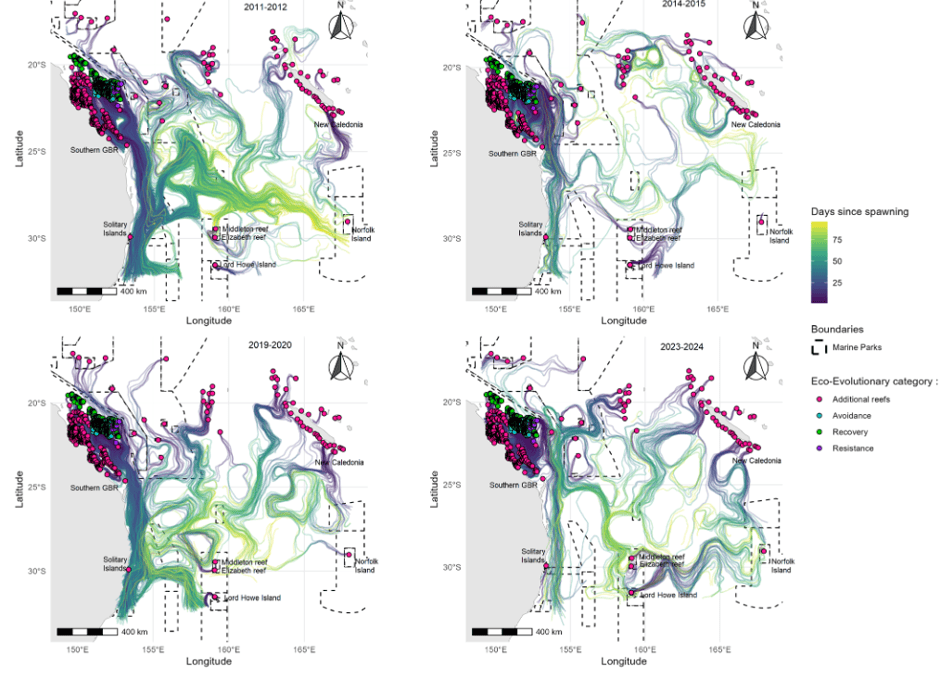
Figure 1 – A map of the simulated larvae dispersal pathways in 4 different time periods. Each reef is represented by a coloured dot according to its categorisation, and larvae pathways are coloured along a gradient based on the elapsed time since spawning. Source: Figure 1 from Dehont et al., 2026.
A Long Voyage
However, the most remarkable findings from this study relate to the connectivity that exists between some of the most isolated reefs of the southwest Pacific. Small island reefs were found to play important roles in larval connectivity even despite their highly remote locations, hundreds of miles off the coast of mainland Australia. In fact, these isolated reefs proved to be important “stepping stones” in the movement of larvae from major sources in the southern Great Barrier Reef to other islands in the Pacific. This idea describes how coral larvae arrived at these reefs, settled there, and then released their next generations of larvae to other reefs further down current. Lord Howe Island in particular was classified as an important stepping stone for coral larvae making this cross-ocean journey.
Reefs were also classified according to their “eco-evolutionary context” – this included whether the reefs had previously been identified as being particularly heat-resilient, located in naturally-cooler areas, or able to recover rapidly after disturbances. When the patterns of larvae dispersal were analyzed in light of these categories, some more interesting results were found. Reefs located in naturally-cooler regions were critical sources of larvae. In contrast, reefs found in warmer areas were less effective at supplying larvae to other places. This has important implications – the reefs that might be harbouring tougher, heat-resistant corals are not spreading those corals around the southwest Pacific.
Lastly, the authors also tested how a warming ocean would affect these journeys of coral larvae across the southwest Pacific. Using different projections of ocean warming, the model was able to predict how ocean temperature would affect larval dispersal patterns based on their increased mortality in warmer water. As expected, connectivity between reefs was greatly decreased in all of the warming scenarios – at 1°C of warming this decrease was around 67%, and at 2.5°C connectivity was predicted to drop by an enormous 83%.
The Journey Ahead
So what can we learn from connectivity studies such as these, and how can this information be practically applied in conservation work? Besides providing us a better understanding of how larvae are moving throughout this region, this work has a number of important and direct implications for coral reef management. Firstly, it is clear that isolated reefs should be recognized as crucial connectivity stepping stones and therefore allocated greater attention for the protection of their reefs. These reefs play a crucial role in supporting larval export across the southwest Pacific, and play a role that cannot be reproduced elsewhere. Secondly, reefs identified as critical sources in the southern Great Barrier Reef may need to be prioritized for effective management as well. These reefs were typically found to be simultaneously important feeder reefs in terms of their larval supply, but also highly unprepared for ocean warming given their naturally cooler waters.
Studies such as these also provide reason for optimism for coral reefs. It is clear that the reefs of this region are highly connected, even at short timescales of individual years, and even at the large distances involved in reaching some of the most isolated islands. This means that, on the path to natural recovery of degraded coral reefs, nature is already doing much of the work. Even just a few well-targeted initiatives aiming to protect, restore and support threatened reefs may have powerful impacts beyond their borders, since the corals that make up the reef are moving around more than you might imagine.
References
Dehont, E., Choukroun, S., Grech, A. and Quigley, K.M., 2026. Limited source–sink connections shape south‐western Pacific coral reef resilience under current and future warming. Journal of Applied Ecology, 63(4), p.e70376.
Graham, E.M., Baird, A.H. and Connolly, S.R., 2008. Survival dynamics of scleractinian coral larvae and implications for dispersal. Coral reefs, 27(3), pp.529-539.
King, S., Saint-Amand, A., Walker, B.K., Hanert, E. and Figueiredo, J., 2023. Larval dispersal patterns and connectivity of Acropora on Florida’s Coral Reef and its implications for restoration. Frontiers in Marine Science, 9, p.1038463.
Mayorga-Adame, C.G., Batchelder, H.P. and Spitz, Y.H., 2017. Modeling larval connectivity of coral reef organisms in the Kenya-Tanzania region. Frontiers in Marine Science, 4, p.92.
Pysanczyn, J.W., Williams, E.A., Brodrick, E., Robert, D., Craggs, J., Marhaver, K.L. and Simpson, S.D., 2023. The role of acoustics within the sensory landscape of coral larval settlement. Frontiers in Marine Science, 10, p.1111599.
Sakai, Y., Kato, K., Koyama, H., Kuba, A., Takahashi, H., Fujimori, T., Hatta, M., Negri, A.P., Baird, A.H. and Ueno, N., 2020. A step-down photophobic response in coral larvae: implications for the light-dependent distribution of the common reef coral, Acropora tenuis. Scientific Reports, 10(1), p.17680.
Thompson, D.M., Kleypas, J., Castruccio, F., Curchitser, E.N., Pinsky, M.L., Jönsson, B. and Watson, J.R., 2018. Variability in oceanographic barriers to coral larval dispersal: Do currents shape biodiversity?. Progress in Oceanography, 165, pp.110-122.

