
Written by Larissa Marques Pires-Teixeira
Feature image from Guy Stevens | Manta Trust
We often find ourselves at the beach, hearing the sounds of seabirds or watching flocks flying close to the shoreline. Few people realize that these birds are helping to feed and sustain entire ecosystems. There is a deep and interdependent ecological relationship between coral reefs and seabirds, and although they may seem distinct, they are closely connected. Seabirds play a fundamental role in the transfer and concentration of nutrients to coastal coral reefs, especially when they return to land after foraging in the open ocean.
Nutrients from the sky
Seabirds spend most of their lives at sea, feeding on fish and other organisms. When they return to islands to rest and breed, they bring with them nutrients from the ocean in the form of guano. It may not sound glamorous, but guano is extremely rich in nitrogen and phosphorus—nutrients that are often scarce in tropical waters. As it accumulates on island soils, rainfall washes these nutrients into the sea. Seabirds are therefore important global drivers of nutrient cycling, transferring elements from their ocean feeding grounds to coastal and insular ecosystems [1].
In a study conducted in the Chagos Archipelago, Graham et al. [2] compared islands that support large seabird colonies with islands where invasive rats have drastically reduced these populations. Islands with high seabird densities showed substantially elevated levels of stable nitrogen isotopes (δ¹⁵N) in soils, vegetation, macroalgae, filter-feeding sponges, and reef fish in adjacent coral reefs [2]. Stable nitrogen isotopes are widely used in ecological studies as natural tracers because they help identify the origin of nutrients and track their movement across ecosystems and trophic levels. In this case, the elevated δ¹⁵N values show that nitrogen derived from seabird guano is incorporated into a wide range of organisms, highlighting the strong ecological connection between terrestrial and marine ecosystems.
Additional evidence shows that corals located near seabird colonies exhibit significantly higher growth rates than those in areas without seabird influence. These natural subsidies provided by seabirds can stimulate coral productivity and development, playing a positive role in the functioning and resilience of reef ecosystems [3].
Beyond nutrient inputs
Seabirds do more than fertilize reefs; they drive key ecological processes, increasing productivity and strengthening biological controls that maintain the balance of trophic relationships in reef environments. Guano, for instance, can increase nutrient availability in reefs, boosting primary productivity, particularly of algae. This increase at the base of the food web supports higher productivity and biomass of herbivorous fish, which in turn exert stronger grazing pressure on algae, helping maintain reef balance [4].
Guano-derived nitrogen can even influence how corals obtain energy. The coral Pocillopora damicornis can obtain energy in two ways, depending on nutrient availability. It can rely on autotrophy through photosynthesis performed by the microscopic algae living within its tissues, known as symbiotic zooxanthellae. Alternatively, it can obtain energy through heterotrophy by capturing food particles, primarily microorganisms, from the surrounding water column. . In nutrient-enriched areas, corals tend to rely more on autotrophy, whereas in nutrient-poor environments, heterotrophy becomes more prevalent.
In this case, the nutrients supplied by seabirds alter the coral’s feeding strategy, a phenomenon known as trophic plasticity. This flexibility allows corals to adjust how they obtain energy according to environmental conditions and can help them better withstand climate-related stress. By supplying nutrients, seabirds may therefore play an important role in enhancing the resilience of coral reefs. [5].
Seabirds connect different ecosystems
Another key role of seabirds is as ecological connectors. The transfer of matter and energy across ecosystems, known as ecological subsidies, relies heavily on these birds. As seabirds move between feeding grounds in the open ocean and nesting sites on islands, they transport nutrients that can eventually reach nearby coral reefs. [6]. Beyond local scales, seabirds act as global mediators of connectivity between land and sea, redistributing marine-derived nutrients to insular and coastal systems [7].
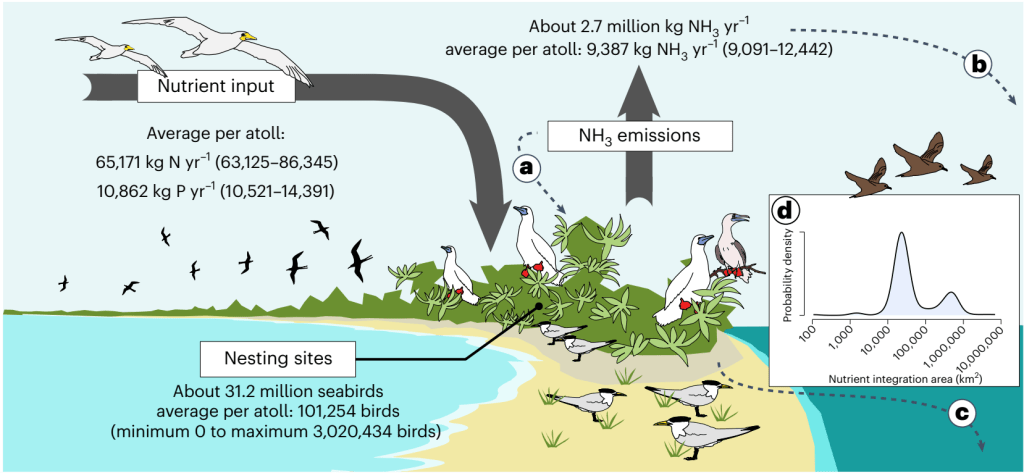
Image representing the reciprocal relationship between seabirds and atolls, ring-shaped oceanic islands formed by coral reefs surrounding a central lagoon (Steibl et al., 2024).
A new perspective on coral reefs
The next time you think about coral reefs, don’t picture only colorful fish and crystal-clear waters. Seabirds are part of this story, transporting nutrients across vast distances, shaping food webs, and helping sustain life underwater. Coral reefs, after all, do not depend solely on the sea. They also depend on the sky.
References
[1] Otero, X. L., De La Peña-Lastra, S., Pérez-Alberti, A., Ferreira, T. O., & Huerta-Diaz, M. A. (2018). Seabird colonies as important global drivers in the nitrogen and phosphorus cycles. Nature Communications, 9(1), 246. https://doi.org/10.1038/s41467-017-02446-8
[2] Graham, N. A., Wilson, S. K., Carr, P., Hoey, A. S., Jennings, S., & MacNeil, M. A. (2018). Seabirds enhance coral reef productivity and functioning in the absence of invasive rats. Nature, 559(7713), 250-253. https://doi.org/10.1038/s41586-018-0202-3
[3] Savage, C. (2019). Seabird nutrients are assimilated by corals and enhance coral growth rates. Scientific Reports, 9(1), 4284. https://doi.org/10.1038/s41598-019-41030-6
[4] Benkwitt, C. E., Zora, A., Ebrahim, A., Govinden, R., Lange, I. D., Evans, S., Schulze, M., Cotton, E., Bennett, L., & Graham, N. A. J. (2025). Nutrient connectivity via seabirds enhances dynamic measures of coral reef ecosystem function. PLOS Biology, 23(7), e3003222. https://doi.org/10.1371/journal.pbio.3003222
[5] Thibault, M., Houlbreque, F., Duprey, N. N., Choisnard, N., Gillikin, D. P., Meunier, V., Benzoni, F., Ravache, A., & Lorrain, A. (2022). Seabird-derived nutrients supply modulates the trophic strategies of mixotrophic corals. Frontiers in Marine Science, 8, 790408. https://doi.org/10.3389/fmars.2021.790408
[6] Lundberg, J., & Moberg, F. (2003). Mobile link organisms and ecosystem functioning: implications for ecosystem resilience and management. Ecosystems, 6(1), 0087-0098. https://doi.org/10.1007/s10021-002-0150-4
[7] Steibl, S., Steiger, S., Wegmann, A. S., Holmes, N. D., Young, H. S., Carr, P., & Russell, J. C. (2024). Atolls are globally important sites for tropical seabirds. Nature Ecology & Evolution, 8(10), 1907-1915. https://doi.org/10.1038/s41559-024-02496-4

