
Written by Andrea Melina Fonseca-Tovar
Edited by Ellie Casement
When we think about coral reefs, we usually imagine crystal-clear waters, colorful fish, and massive coral structures full of life. However, all this beauty and life depends on a less visible but essential process: nutrient recycling. In this dynamic process, fish play a much more important role than previously believed.
A Rich Ecosystem… Sustained by Efficient Nutrient Recycling
Coral reefs are considered one of the most productive and biodiverse ecosystems on the planet. For decades, scientists described reefs as ecosystems thriving in extremely nutrient-poor tropical waters. However, recent research suggests a more nuanced picture.
A recent study (Morais et al., 2025) found that most coral reefs worldwide are actually associated with moderate levels of nitrogen and phosphorus rather than extremely nutrient-poor conditions. This suggests that strong connections between the open ocean and reefs may play a more important role than previously thought. Even so, reefs remain ecosystems where nutrients are rapidly consumed and recycled.
Their extraordinary productivity depends on an extremely efficient nutrient cycling system. Reef organisms — including corals, algae, microorganisms, and fish — continuously capture, transfer, and reuse nutrients within the ecosystem. Nutrients available in the water column are quickly taken up by primary producers, meaning that sustaining higher trophic levels requires a constant and efficient recycling network.
This is where fish become especially important: they help redistribute nutrients throughout the reef, supporting the complex food webs that maintain coral reef productivity and biodiversity.
Fish as Reef “Fertilizers”
Fish not only add color and movement to reefs; they also function as living reservoirs of nutrients. Through feeding, metabolism, and excretion, they store, transform, and redistribute essential substances such as nitrogen (N) and phosphorus (P).
Each species contributes differently depending on its size, diet, and position in the food chain. Small fish, for example, have faster metabolisms and recycle nitrogen at higher rates. Large fish, especially predators, contribute more phosphorus because of their animal-rich diets. This constant nutrient exchange maintains ecosystem productivity and supports essential processes such as coral growth, beneficial algal production, and the chemical balance of the reef.
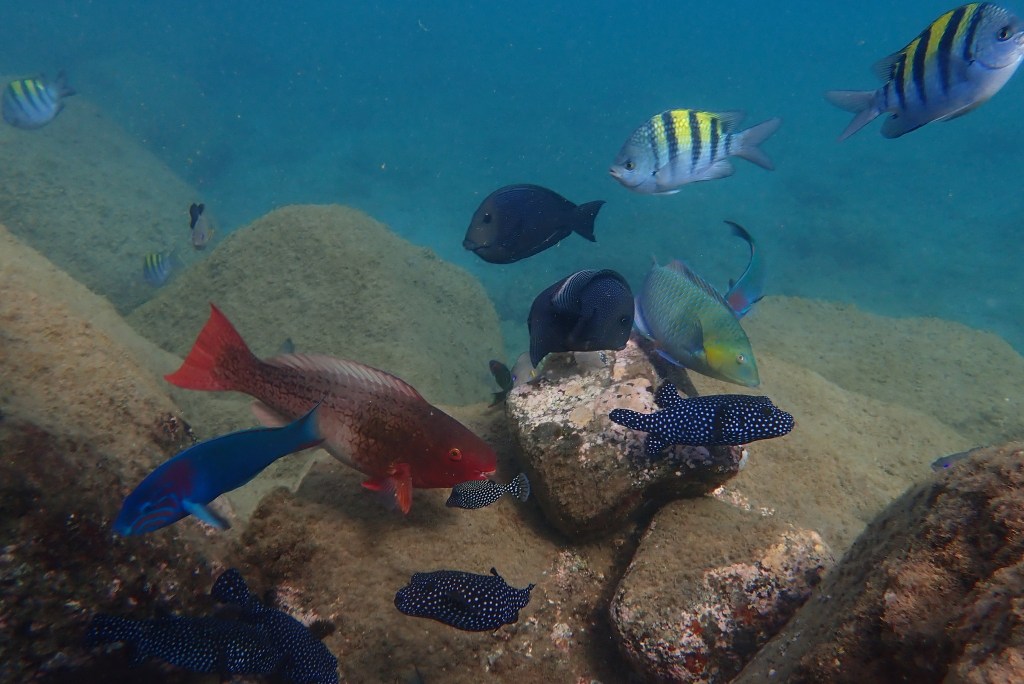
Figure 1. Fish diversity on a coral reef. Photograph by Héctor Alejandro Hernández Castellanos.
More Important Than the Number of Species
For many years, species richness, meaning how many species exist in an ecosystem, was considered the main indicator of ecological health. However, this research reveals a more complex reality. What truly matters is not only how many species are present, but also what kinds of fish make up the community. Factors such as fish body size, ecological role, and position in the food chain influence nutrient dynamics more strongly than the simple number of species. For example, a reef may still contain many different species, but lose much of its functional capacity if large fish or predators disappear.
Biodiversity Does Not Always Mean Functionality
Another important finding is that so-called “functional redundancy” has limits. This concept suggests that several species can perform similar functions within an ecosystem, meaning that if one species disappears, others could replace it. But in coral reefs, this is not always the case. The research found that certain species have a disproportionately large impact on nutrient recycling. Therefore, even if a reef maintains high diversity, the loss of key species can seriously affect ecosystem functioning.
Fishing Alters Nutrient Flow
The study demonstrates that fishing does more than reduce fish populations: it also profoundly alters ecosystem functioning. When fish are removed through fishing activities, two major processes occur:
- Nutrients stored in fish bodies are removed from the reef.
- The structure of fish communities changes.
This is especially serious because fisheries often target large fish and species at higher trophic levels, such as predators. As these species disappear, reefs lose organisms that are critical for nutrient recycling. This study suggests that in heavily fished reefs, the ability to store and recycle nutrients can be reduced by nearly half (Fig. 2).
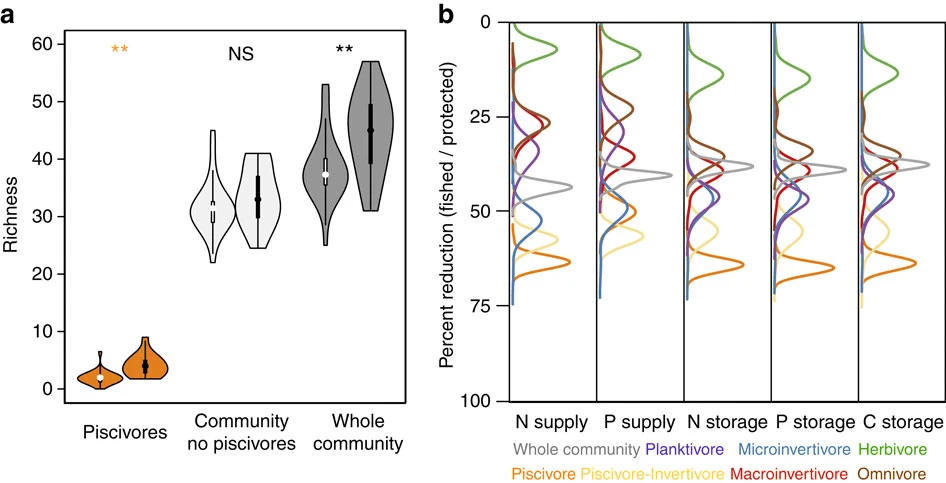
Figure 2. In the first section (a), the number of reef species lost due to fishing is depicted, and predatory fish (orange) are shown to be the most affected group. Fished reefs (bars with white center) contain fewer piscivorous species compared to protected reefs (bars with black center), while the rest of the community changes much less between fished and non-fished reefs. In the second section (b), the figure illustrates how fishing greatly reduces the capacity of fish to store and recycle nutrients such as nitrogen and phosphorus. Even when many species remain present, the loss of large predatory fish decreases nutrient flow within the reef, affecting overall ecosystem functioning. From Allegeier et al., 2016.
A Global Problem
The decline of reef fish threatens not only marine biodiversity, but also the ecological stability and food security of millions of people who depend on reefs for food and livelihoods. In addition, the recovery of these fish communities can take decades. Some studies estimate that reef fish biomass may require between 35 and 60 years to recover after intense exploitation (MacNeil et al., 2015). This means that the effects of fishing on nutrient flow can persist for generations.
Protecting Fish Means Protecting Reefs
Traditionally, reef conservation has focused on protecting species and reducing pollution. However, this study suggests that we must also consider the role of fish as drivers of nutrient recycling. Conserving fish species does not only mean preserving biodiversity; it means protecting the entire functioning of the ecosystem. Coral reefs survive through delicate nutrient cycles in which every organism plays a role. Among them, fish act as fertilizers that keep reefs alive and thriving. Without them, the invisible balance of the ecosystem slowly begins to break down beneath the ocean’s surface.
Read the full article here: Allgeier, J. E., Valdivia, A., Cox, C., & Layman, C. A. (2016). Fishing down nutrients on coral reefs. Nature Communications, 7(1), 12461. https://doi.org/10.1038/ncomms12461
Referencess

