
Written by Ana Carolina Grillo
When we think about coral reefs, what often comes to mind is a peaceful, colorful community of organisms on the seafloor, with several very busy fish swimming around them. But beneath this apparently peaceful scene, a battle for space is constantly taking place.
There’s no such thing as personal space on the reef
Many of the organisms that cover the reef are sessile, meaning they cannot swim away and are permanently attached to the seafloor. Sessile organisms, like hard corals, algae, soft corals, and sponges, need a hard surface to settle on, and as they grow, they need more and more space. Since reefs are packed with organisms competing for the same real estate, these creatures have evolved different ways to protect their ‘personal space’, and, in some cases, to invade their neighbors’ territory.
For example, some erect macroalgae can constantly rub against corals, harming their delicate tissues. Others, such as soft corals and zoantharians, can grow rapidly and take over the reef, growing over organisms that are already settled there. This can suffocate and kill the corals underneath. Some competitors take a more chemical approach, producing and releasing substances that can damage coral tissue and expose their skeleton.
Hard corals (which I refer to here simply as ‘corals’) are particularly important because they help build and maintain the physical structure of reefs by depositing calcium carbonate. This three-dimensional structure provides shelter and living space for countless fish and invertebrates. When reefs become dominated by soft, non-calcifying organisms such as some macroalgae and soft corals, we can expect less carbonate accumulation and flattening of the reef.
Battles on the reef
Although corals can defend themselves against neighboring organisms, not all of them are equally good at fighting for space. Different coral species have different weapons and different strategies. Some branching corals grow rapidly upwards, reducing the area of contact with the seafloor and, consequently, with their neighbors. Other, slower-growing corals can use tentacles or filaments to sting nearby organisms and even digest their tissue. So, when it comes to the reef battlefield, some corals are strong competitors, while others are more vulnerable. And to make things even more complicated, environmental conditions can change these interactions.
In my last research, I investigated how two coral species from the Great Barrier Reef differ in their ability to fight against a common soft coral called Clavularia koellikeri. This soft coral looks like a collection of tiny flowers (its polyps) and grows attached to the reef by stolons. On shallow reefs, it can spread across large areas, sometimes growing over other organisms in its path.
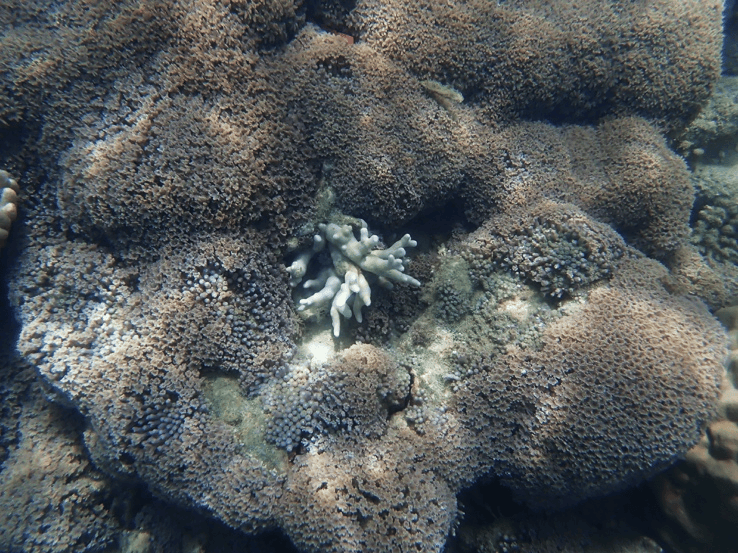
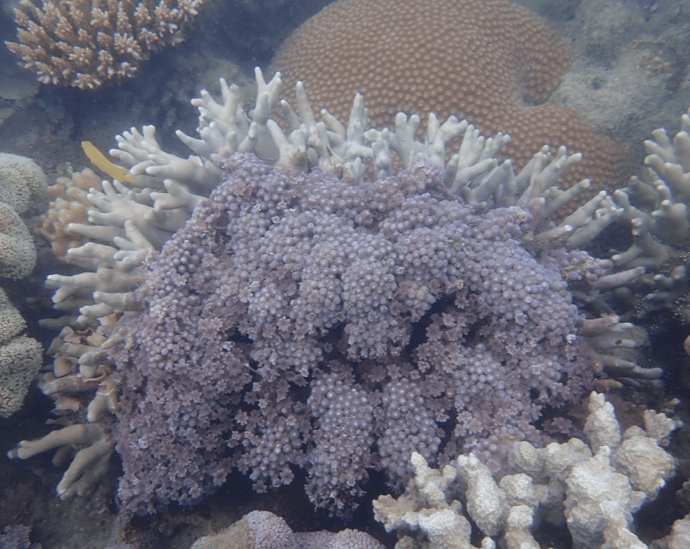
Patches of Clavularia surrounding (photo on the left) and overgrowing (photo on the right) branching Porites corals
When I first went to the field at Orpheus Island, Australia, I noticed that several large colonies of branching and massive corals of the genus Porites appeared to be damaged and overgrown by Clavularia, while most corals of the genus Acropora seemed to be doing just fine when in contact with the soft coral. Could Acropora be better at fighting back?
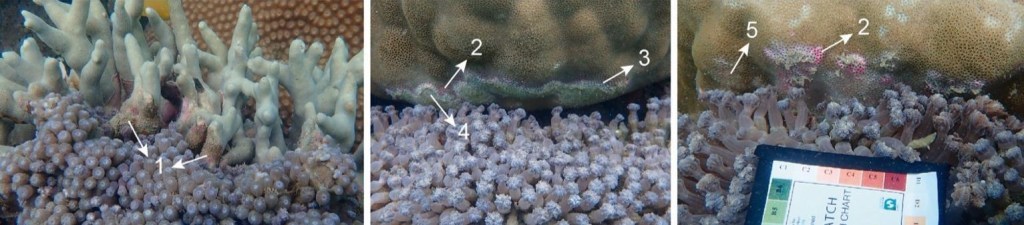
Detailed photographs showing examples of damaged tissue in branching and massive Porites corals
Taking the battle to the lab
To test this idea, and to understand how Clavularia competes with corals, I brought these organisms into the laboratory and set up a series of experiments. First, I simulated competition for space in small aquaria by placing pairs of different species very close together until they touched, mimicking what happens on the reef when their tissues come into contact. I monitored the corals closely throughout the experiment. After 17 days, Porites had developed larger areas of tissue damage than Acropora.
But the most interesting discovery came from watching the interactions day after day in detail. I noticed that Clavularia did not behave the same way when interacting with the two corals. Its polyps (the tiny “flowers” I mentioned earlier) can change their direction depending on what is happening around them. When Clavularia was next to Acropora, its polyps were usually closed or pointed away from the coral, almost as if they were saying, “Nope, not going there.” When interacting with Porites, the polyps sometimes touched the coral and sometimes did not. To make sure this behavior was not simply a response to having something nearby, I placed an inert object next to Clavularia. In this case, its polyps remained open and extended toward the object.
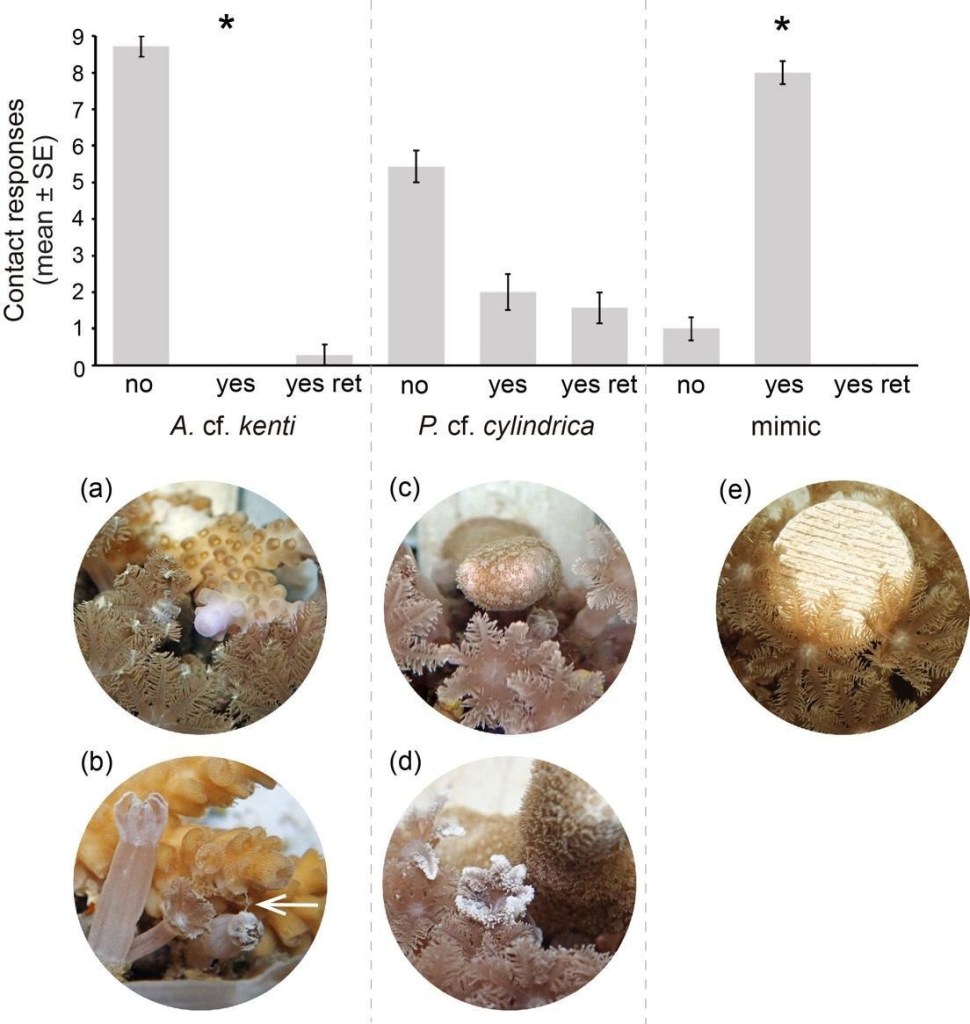
Contact responses of the soft coral Clavularia koellikeri when interacting with the hard corals Acropora cf. kenti, Porites cf. cylindrica, and the inert mimic: no (polyps of C. koellikeri not touching the competitor), yes (polyps of C. koellikeri expanded and touching the competitor), yes ret (yes but retracted, polyps of C. koellikeri retracted and touching the competitor); *p < 0.05.
Photographs demonstrating (a) retracted tentacles of C. koellikeri not contacting A. cf. kenti; (b) extrusion of mesenterial filament (arrow) of A. cf. kenti onto C. koellikeri; (c) expanded and retracted polyps of C. koellikeri not contacting P. cf. cylindrica; (d) retracted polyp of C. koellikeri contacting P. cf. cylindrica; (e) expanded polyps of C. koellikeri contacting the mimic.
These observations suggest that Clavularia may avoid physical contact with Acropora, potentially because Acropora has a defensive mechanism that repels the soft coral at very small spatial scales. At one point, I could even see a mesenterial filament (a structure used by corals in aggressive interactions) protruding from Acropora toward Clavularia.
Chemical weapons
I also wanted to know if Clavularia could fight chemically apart from using physical mechanisms, as some other soft corals do. To test this, I extracted chemicals from Clavularia and incorporated them into a gel – essentially a tiny scientific version of Jell-O. I cut the gel into small pieces (imagine a very small 1 cm² piece of Jell-O) and attached them to the two corals and waited 24 hours. For comparison, I repeated the experiment using another soft coral known to produce toxic chemical compounds, Sarcophyton. Again, the chemicals from Clavularia caused more damage to Porites than to Acropora. However, the contrast became even clearer when I compared Clavularia with Sarcophyton: the chemicals from Sarcophyton caused much stronger damage on corals, including a greenish injury on Porites. This suggests that the chemicals produced by Clavularia are less potent than those of Sarcophyton when it comes to damaging corals, and that Clavularia might rely more on physical than on chemical means to gain space on the reef.
So, who wins the battle?
Together, these experiments reveal how complex life on a coral reef can be. What may look like a peaceful community from above is actually a constant negotiation, and sometimes a full-blown battle for space. In these battles, the identity of your neighbor matters, and there is no single winner. The outcome depends on who is fighting whom, and on the weapons each organism brings to the fight.
These tiny interactions may seem insignificant, but when they happen over and over across a reef, they can help determine which organisms will dominate and, ultimately, what that reef looks like and how it functions.
Reference:
Grillo, A. C., Longo, G. O., Hoey, A. S., Hoogenboom, M. O. (2026). Competition mechanisms of the common soft coral Clavularia koellikeri for benthic space domination. Marine Ecology Progress Series, 793: 15216. https://doi.org/10.3354/meps15216

