
Written by Brandon Sosa
When your floors are dirty, you can sweep, you can vacuum, or you can have a Roomba do it for you. Coral reefs have their own version of dirty floors: algae. So how do we clean them? And more importantly — what is the Reef Roomba in this scenario?
The Problem with the Reef Floor
Coral reefs need free space for corals to settle, grow, and survive. Algae, which grows far faster than coral, is the primary competitor for that space. If left unchecked, algae wins. From 1983 to 1984, the long-spined sea urchin (Diadema antillarum), a key marine grazer that feeds on algae, suffered mass mortality throughout the Caribbean, Florida, and Bermuda. Its loss contributed to many Caribbean reefs changing from coral-dominated to algae-dominated communities — a process known as a “phase shift” (Lessios 2016). Urchin populations were reduced by an average of 98%, and algal communities responded rapidly. At some sites, algal biomass increased within days of urchin losses (Hylkema et al. 2023). Many Caribbean reefs never fully recovered, even to this day. As such, restoration efforts that outplant corals directly into algae-dominated conditions often result in low long-term coral survival (Wilson et al. 2025). The path to recovery requires more than just adding corals to algae-smothered substrate.
Meet the Reef Roombas
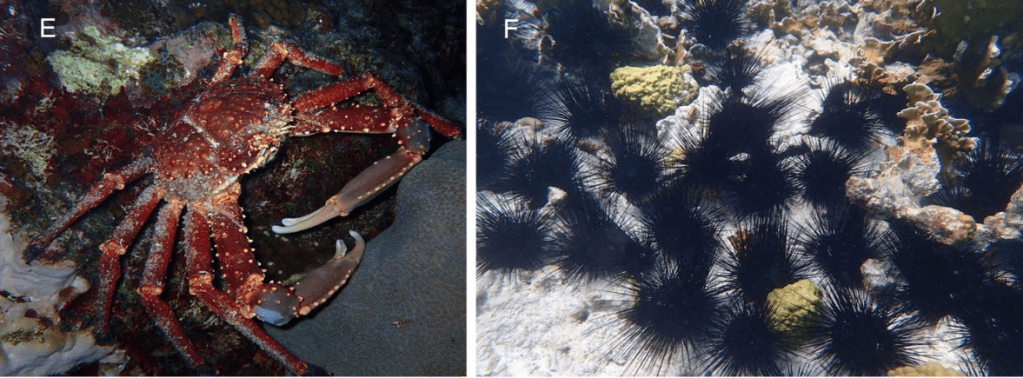
The Caribbean grazer guild is more diverse than most people realize. Sea urchins like D. antillarum are the poster species: wide-ranging, hungry, and historically abundant. This has led to active efforts to culture and restock them across Florida and the wider Caribbean. However, the Caribbean king crab (Maguimithrax spinosissimus) has emerged as a compelling complement. Unlike most urchins and fish, M. spinosissimus can consume chemically and physically defended macroalgae, including Amphiroa, Halimeda, and Dictyota, which other grazers tend to avoid (Butler et al. 2024). By clearing away algae and exposing bare reef substrate, these grazers create conditions for corals to establish themselves, either through active outplanting or natural recruitment of juveniles. Herbivorous fish, particularly parrotfish, round out the grazing guild, though restoring fish populations relies more on fisheries management than on active restocking (Wilson et al. 2025). Each grazer plays a slightly different role, but the logic of teamwork is intuitive: a diverse bench of grazers is likely best, each picking up the slack where others may come up short. This teamwork is especially important given the differences across reefs in conditions, stressors, and the presence of predators that may target specific grazer species.
Beyond the Usual Suspects
Urchins and crabs aren’t the only candidate Roombas on researchers’ radar. Alongside D. antillarum and M. spinosissimus, two additional sea urchin species — the West Indian sea egg (Tripneustes ventricosus) and the reef urchin (Echinometra viridis) — have recently been incorporated into active restoration programs (Wilson et al. 2025). T. ventricosus is a promising restoration addition, as it effectively consumes algal communities across a range of species, from new growth to thicker, more established seaweeds. E. viridis, while more cryptic in behavior, can remove similar amounts of seaweed as D. antillarum when present at high enough densities (Butler et al. 2024). Learning how to raise these grazers in captivity, especially through their larval stages, was the first hurdle, and real progress has been made. Now the field is wrestling with trickier questions: Which grazers work best where? How can production be scaled up? How many grazers are needed to actually shift a reef away from algal dominance?, And once released, will these grazers stick around long enough to make a difference?
A Growing Movement
From Puerto Rico to the Florida Keys, the Dutch Caribbean, and Antigua, a growing network of research institutions, conservation organizations, and reef managers is working toward grazer restoration at a meaningful scale. This includes groups like ISER Caribe, the Florida Aquarium, Mote Marine Laboratory, the Elkhorn Marine Conservancy, the Healthy Reefs for Healthy People Initiative, Florida Fish and Wildlife, the University of Florida, Florida International University, the University of Puerto Rico, Van Hall Larenstein University, the University of Miami, and many more. Challenges in large-scale mariculture — the farming and rearing of marine organisms — remain, particularly in the larval and juvenile life stages. Stocking effectiveness and monitoring feasibility present significant outstanding challenges across all species and phases of restoration (Wilson et al. 2025). However, we now know that many candidate grazer species exist, their biology is increasingly well understood, and their importance to coral reef health has never been more apparent.
The Reef Roomba may be slow, spiny, or sideways-walking, but right now it might be one of the most important workers on the reef.
References
- Butler, M. J., Duran, A., Feehan, C. J., Harborne, A. R., Hylkema, A., Patterson, J. T., Sharp, W. C., Spadaro, A. J., Wijers, T., & Williams, S. M. (2024). Restoration of herbivory on Caribbean coral reefs: Are fishes, urchins, or crabs the solution? Frontiers in Marine Science, 11, 1329028. https://doi.org/10.3389/fmars.2024.1329028
- Hylkema, A., Kitson-Walters, K., Kramer, P. R., Patterson, J. T., Roth, L., Sevier, M. L. B., Vega-Rodriguez, M., Warham, M. M., Williams, S. M., & Lang, J. C. (2023). The 2022 Diadema antillarum die-off event: Comparisons with the 1983–1984 mass mortality. Frontiers in Marine Science, 9, 1067449. https://doi.org/10.3389/fmars.2022.1067449
- Lessios, H. A. (2016). The great Diadema antillarum die-off: 30 years later. Annual Review of Marine Science, 8, 267–283. https://doi.org/10.1146/annurev-marine-122414-033857
- Patterson, J. T., O’Neil, K., Ladd, M., Williams, D., & Spadaro, J. (2023). Improving and expanding the portfolio of grazers available for coral co-culture and reef restoration (Florida Department of Environmental Protection Report, pp. 1–34). Florida Department of Environmental Protection.
- Wilson, M. W., Bigler, M., Renaud-Byrne, G., Gutiérrez Plata, S., Hylkema, A., Patterson, J. T., Pilnick, A., Spadaro, A. J., & Williams, S. M. (2025). Employing invertebrates to restore herbivory on Caribbean coral reefs: Recent developments and remaining barriers. Restoration Ecology, 33, e70025. https://doi.org/10.1111/rec.70025
Images from Butler et al. 2024 Figure 1E, 1F (Caribbean King Crab, Maguimithrax spinosissimus; Mithracidae (photo credit: AJ Spadaro). Long-spined Sea Urchin, Diadema antillarum; Diadematidae (photo credit: Alwin Hylkema)).
 Reefbites