
Written by Andrea Melina Fonseca-Tovar
In the context of the International Day of Women and Girls in Science, I want to write about the study by Al-Gergawi et al. (2024) on women’s participation in coral reef research in the countries of the Gulf Cooperation Council (GCC-Persian Golf). Although geographically distant for many readers, the scientific reality of this region reflects global challenges: the marine environmental crisis and the persistent gender inequality in academia.
A Temporal and Gender Gap
Coral reefs in the Persian Gulf have experienced a steady decline since the 1970s, a period that coincides with the onset of the oil boom, which acted as a major catalyst for rapid coastal urbanization. Large-scale landfilling and coastal reclamation increased sedimentation and degraded water quality, smothering coral colonies and reducing the light available for photosynthesis by their symbiotic algae. At the same time, population growth intensified coastal development, leading to higher levels of pollution, nutrient runoff, and physical disturbance, all of which have reduced the resilience of reef systems and their capacity to recover from environmental stress. As a result of these combined pressures, live coral cover has decreased by more than 40% in just two decades. The loss of these ecosystems extends well beyond biodiversity. Coral reefs are among the most diverse marine environments because their complex three-dimensional structures provide shelter, breeding grounds, and feeding areas for numerous species, while also supporting fisheries, tourism, and the food security of many coastal communities.
Given the accelerating decline of the coral reef ecosystem and the urgent need for effective conservation strategies, the production of scientific knowledge has become a critical tool for their protection. However, access to marine science, and particularly opportunities to participate in research, are not equally distributed. Gender inequality remains a persistent issue in scientific research, including coral reef studies, limiting who can contribute to the next generation of knowledge and to decision-making processes. In this context, the underrepresentation of women is not only a question of numbers, it also restricts the diversity of perspectives that shape research agendas, influence methodological approaches, and inform conservation practices. This is especially critical at a time when coral reefs are already under pressure from coastal urbanization, land reclamation, pollution, human population growth, and climate change, as unequal participation in science reduces our collective capacity to respond effectively to these interconnected stressors.
The Voice of Women
To understand these dynamics, Al Gerwagi et al. led a research team to investigate gender representation in coral reef science in the Persian Gulf. The database was compiled of scientific articles on coral reefs in the region published between 1930 and 2021, analyzing how often women appeared as authors and as laboratory leaders (that is, in the last authorship position). Additionally, interviews were conducted with female scientists who had contributed to those publications, to learn about their experiences, the barriers they face when publishing, the dynamics within research teams, and the challenges associated with so-called “parachute science,” a practice in which foreign researchers collect data in the region and publish the results without establishing long-term collaborations, including local scientists as equal partners, or investing in local training, infrastructure, and research capacity.
Inclusion That Is Still Not Enough
The results show contrasting trends in gender participation. Although the number of women involved in coral reef research has increased sixfold over the past decade (Figure 1), this rise does not necessarily indicate a proportional increase in inclusion, but may instead reflect a greater number of women entering the field. Women currently account for approximately one in three authors overall. While their growing presence as first authors suggests active participation in the production of scientific knowledge, they remain underrepresented in the last authorship position, which is commonly used as a proxy for principal investigators or laboratory leaders (Figure 2). Their concentration in middle-authorship positions, together with their limited representation in senior-authorship roles, indicates that structural barriers continue to restrict their influence over research agendas, access to resources, and decision-making processes.
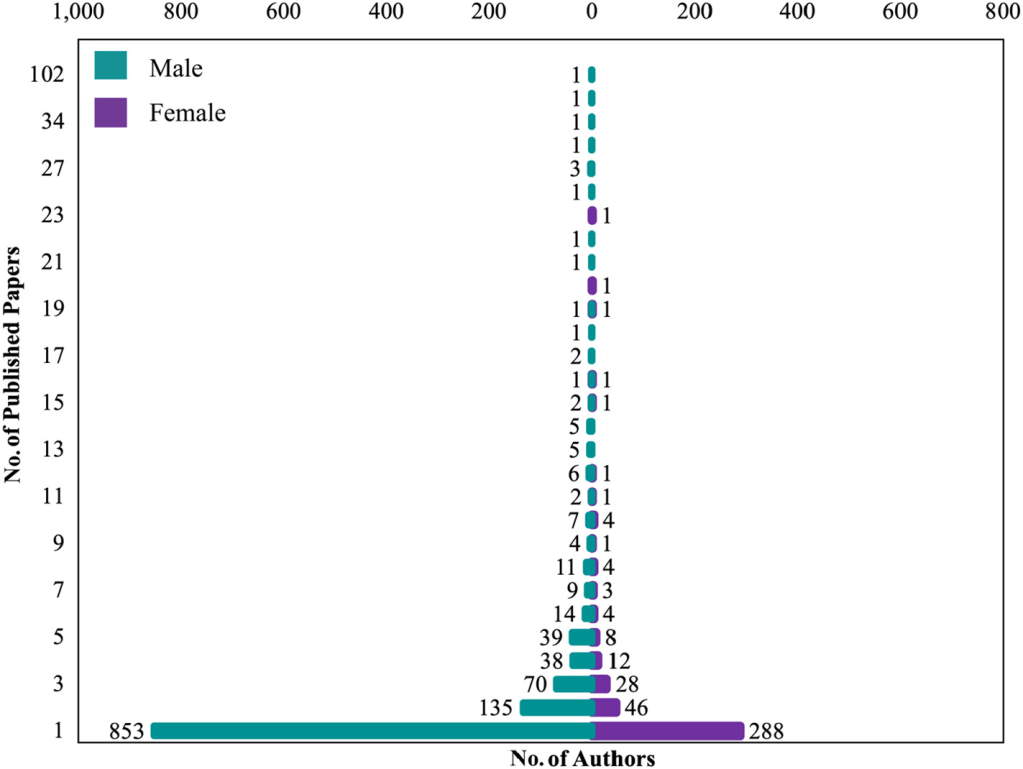
Figure 1. Number of publications from 1930 to 2021, broken down by biological sex. (Figure taken from Al-Gergawi et al., 2024).
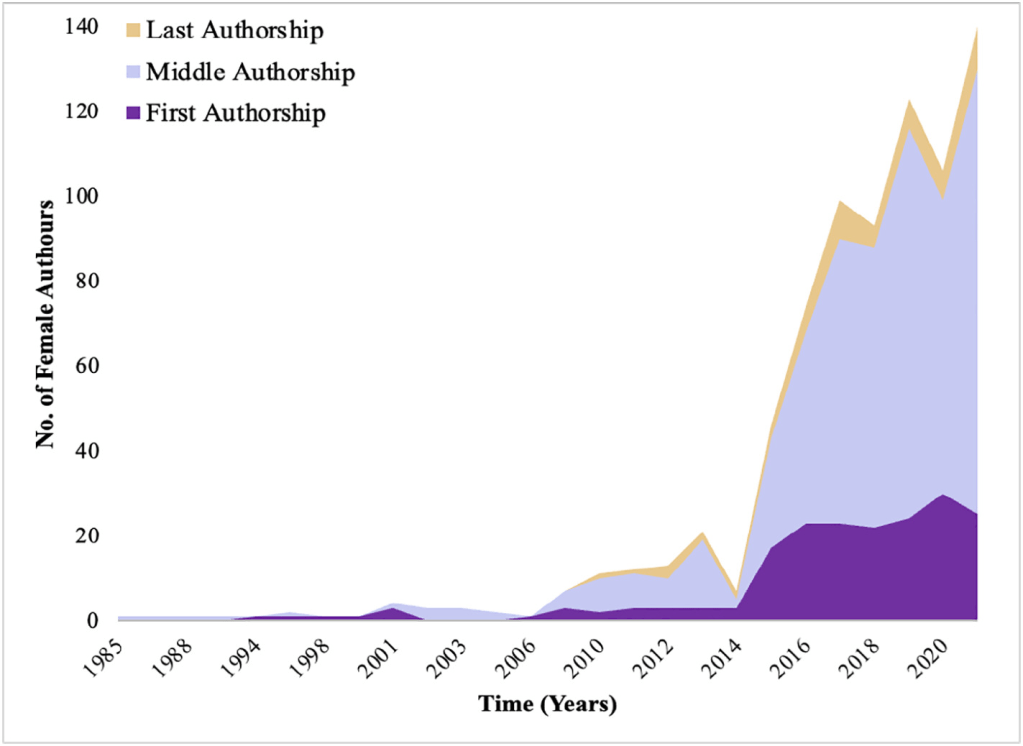
Figure 2. Number of women authors, broken down by authorship position, in coral reef science publications that include women over time in the GCC. (Figure taken from Al-Gergawi et al., 2024).
Although women’s access to science has increased, the gender gap persists and is linked to specific factors: the pressure of an academic system based on “publish or perish,” the greater burden of domestic and caregiving work, cultural expectations, impostor syndrome, and the dynamics of recognition within research teams. While each of these can affect many people in academia on its own, together they generate a cumulative effect that tends to become more visible and have a stronger impact on women’s career paths.
All Voices Are Needed
Previous research has shown that women’s participation can strengthen marine governance and improve conservation outcomes. For example, studies on small-scale fisheries management have found that the inclusion of women in decision-making processes is associated with more sustainable resource use and greater community compliance with conservation measures [1]. Similarly, research on environmental leadership indicates that gender-diverse scientific teams tend to produce more innovative solutions and address socio-ecological problems more comprehensively [2]. By bringing different experiences, knowledge systems, and research priorities, a more diverse scientific community is better equipped to respond to the complex and interconnected challenges facing coral reef ecosystems.
Support and Local Research
The study also reveals a strong dependence on researchers from the Global North (Europe and North America), who produce most of the scientific output on the Gulf’s reefs. Although this pattern is partly linked to the region’s high migrant population, it raises concerns about the long-term sustainability of knowledge production. When research is led mainly by temporary external experts, projects often lack continuity, opportunities to build local capacity are reduced, and the perspectives and needs of local communities can be overlooked.
Proposals for Change
Several actions can help reduce these inequalities. These proposals include promoting marine sciences as a career option from the earliest stages of education to strengthen local talent and increasing funding and leadership opportunities for early-career women researchers, particularly in public institutions. It is also necessary to implement evaluation and selection processes that reduce bias and to foster more flexible working conditions that support a better balance between academic and personal life. In addition, the criteria used to define scientific excellence should be broadened to recognize social impact, mentorship, and community-engaged research.
In an ocean in crisis, knowledge production cannot remain unequal. Strengthening the participation of women and local communities is not only a matter of social justice, but a necessary condition for developing more effective and sustainable conservation strategies. Diversity in science is not an add-on—it is part of the solution.
Read the full article here:
Al-Gergawi, A., Al-Memari, M., Vaughan, G., & Burt, J. A. (2024). The growing role of women in coral reef research in the Gulf Cooperation Council. Biological Conservation, 289, 110411. https://doi.org/10.1016/j.biocon.2023.110411
Glossary
Gulf Cooperation Council (GCC): Comprising Bahrain, Kuwait, Oman, Qatar, Saudi Arabia, and the United Arab Emirates.
Parachute science: A conservation model in which researchers from the developed world travel to developing countries, conduct their studies, and leave without investing in local human capacity or infrastructure. Consequently, this “creates a dependence on external expertise and hinders local conservation efforts” [1].
References
[1] Kleiber, D., LM Harris y ACJ Vincent. 2015. Género y pesca en pequeña escala: Un argumento a favor del recuento de mujeres y más allá. Pesca y Pesca 16 (4): 547–562. https://doi.org/10.1111/faf.12075 .
[2] Campbell LG, Mehtani S, Dozier ME, Rinehart J (2013) Los grupos de trabajo heterogéneos en cuanto a género producen ciencia de mayor calidad. PLoS ONE 8(10): e79147. https://doi.org/10.1371/journal.pone.0079147
[1] Villafuerte, P. (2020, julio 16). Descolonizar la ciencia: ¿qué es “parachute science”? Observatorio / Instituto para el Futuro de la Educación. https://observatorio.tec.mx/ciencia-colonialismo/

