
Written by Ayla Kroon
Edited by Eleanor Casement
More often we see headlines featuring large-scale ocean clean-ups, mentioning quantities of plastic in numbers too large to comprehend. Photos of shopping bags and water bottles floating in the ocean blue evoke shocked and disapproving responses from most people within and outside of the marine science field. This accumulation of plastic, referred to as “Plastic Soup” (Walker, 2020), is visible even from space. Plastic has become a part of our ocean, as unnatural as it may be.
But what about the plastics that we can’t see?
What are microplastics?
Microplastics are small (< 5mm long) plastic particles that are produced when larger plastics break down. These microplastics are present in the ocean water, fish and other organisms (Takahashi et al., 2026). Microplastics in the ocean exist because larger plastics break down into smaller particles through exposure to sunlight and high temperatures. These tiny plastics remain in the water column and are ingested by fish through their food. However, it is less clear if and how microplastics affect other marine organisms, such as corals.
Studying microplastics in corals
Corals are animals that have a calcium carbonate skeleton with a thin overlaying layer of living tissue. A coral’s main structure is a polyp, or small cup-like mouth that has tentacles to help it feed from the water column (Titlyanov & Titlyanova, 2020). These organisms are easily damaged or stressed because they are attached in one place and are therefore unable to move when surrounding conditions become unfavourable. The first time microplastics were reported in corals was in 2015 on the Great Barrier Reef, when Hall et al. (2015) discovered that corals mistake microplastics for prey. Since then, microplastics in corals has been the focus of a variety of studies. However, these methods are often destructive for the coral because they take the coral out of its natural environment, break the skeleton and damage the living tissue (Takahashi et al., 2026).
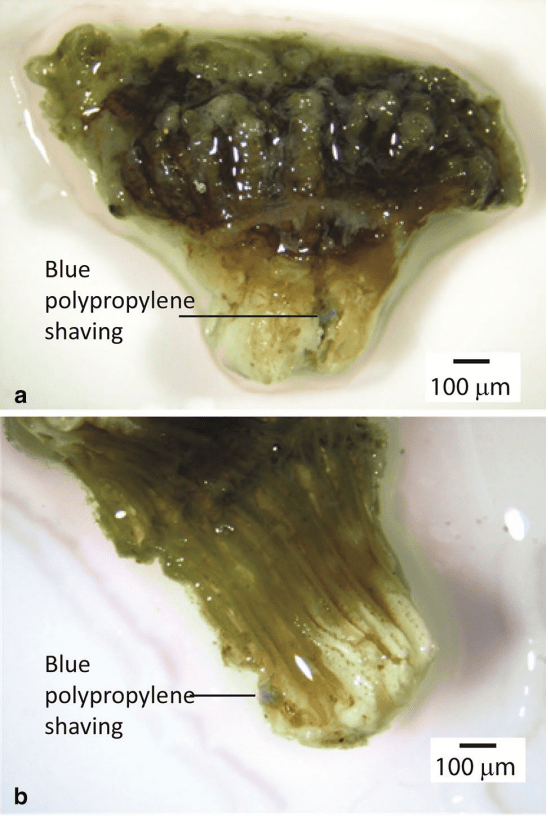
Microplastics found in the mouths of coral polyps (Hall et al., 2015).
A new, rapid, and most importantly non-destructive, method to study microplastics in corals is being developed at the Coral Reef Laboratory of the University of Southampton (Takahashi et al., 2026). CARS, or the Coherent Anti-Stokes Raman Scattering microscope uses multiple lasers fired at the coral sample which in turn produce different fluorescent colours based on what is present in the sample. The coral skeleton naturally has florescence, which showed up as green in the CARS test, whereas polyethylene (PE) microplastic beads show up in a red colour. (Takahashi et al., 2026). Scanning for these microplastic beads, CARS detected PE, the most common type of plastic, in both the living tissue and the skeleton of corals.
Another comparison that was central in this study was between healthy and bleached (unhealthy) corals. Bleached refers to corals that have expelled the algae living in their tissue that usually provide the coral with food and energy, which strips the coral of their colour and leaves it stark white (Titlyanov & Titlyanova, 2020). Interestingly, healthy coral tissue had little to no microplastics, whereas bleached or damaged tissue had a strong accumulation of them. For the coral skeleton, PE particles were only found in corals showing localised tissue loss. An older study by Reichert et al. (2018), looking at a coral’s response in terms of health, feeding interactions, and other responses over a period of 4 weeks after being exposed to microplastics, supports this finding, adding that bleached corals accumulate smaller PE particles in their system for a longer time. This indicates that the health of corals has a strong effect on if and when microplastics end up in the coral tissue and skeleton and possibly stay there.
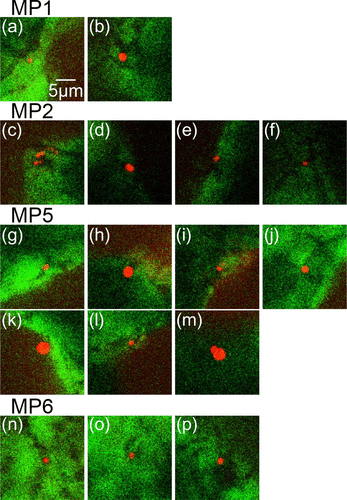
Images of the PE beads (red circles) detected in the skeleton of A. polystoma. (Takahashi et al., 2026).
How are microplastics incorporated into corals?
The most likely route for microplastics to enter coral tissue is through ingestion during tentacle-based feeding (Hall et al., 2015; Takahashi et al., 2026). Bleached and/or damaged corals rely on active feeding from the water column more than healthy corals, because the algae in their tissue that they usually get around 90% of their food intake from are at reduced capacity or removed entirely (Titlyanov & Titlyanova, 2020). This can explain the increased direct uptake of PE in bleached corals. Additionally, according to Takahashi et al. (2026) microplastics attach themselves to damaged tissue. When this tissue eventually grows back, it can overgrow the accumulated PE and in doing so embed the microplastics in the skeleton. This presents a dual pathway for microplastic incorporation in corals, both in their tissue and skeleton.
In the near future corals and coral reefs are expected to experience more frequent and severe coral bleaching events. For stressed corals, this means a higher uptake of microplastics, which will only continue to increase. The new CARS method is a safe and harmless way to study not only the presence, but also the largely unknown long-term effects of microplastics on corals. Active monitoring utilising this method will shed a new fluorescent light on the impacts of microplastics on corals and the reef ecosystem. Hopefully this contributes to a better understanding of the ecological impact so we can protect this ecosystem and its highly diverse inhabitants before coral skeletons become a permanent archive for plastic pollution in our ever-changing oceans.
References:
Hall, N.M., Berry, K.L.E., Rintoul, L. & Hoogenboom, M.O. (2015). Microplastic ingestion by scleractinian corals. Mar Biol 162, 725-732 https://doi.org/10.1007/s00227-015-2619-7
Reichert, J., Schellenberg, J., Schubert, P. & Wilke, T. (2018). Responses
of reef building corals to microplastic exposure. Environ.Pollut. 2018,
237, 955−960
Takahashi, T., D’angelo, C., Kleboe, J., Wiedenmann, J., Foster, G.L. & Mahajan, S. (2026). Studying microplastics incorporation into corals using CARS. Environmental Science & Technology. 60 (4), 3438-3448 https://doi.org/10.1021/acs.est.5c10668
Titlyanov, E.A. & Titlyanova, T.V. (2020). Symbiotic relationships between microalgal zooxanthellae and reef-building coral polyps in the process of autotrophic and heterotrophic nutrition. Russ J Mar Biol. 46, 307-318 https://doi.org/10.1134/S1063074020050107
Walker, Tony. (2020). Michiel Roscam Abbing, Plastic Soup: An Atlas of Ocean Pollution. Ocean Yearbook. 34. 547-549.
 Reefbites