
Written by Andrea Melina Fonseca-Tovar
Anyone who has visited a coral reef can tell you that the organisms that stand out the most are fish. This is due to their bright colors and striking patterns. But have you ever asked yourself what the colors of fish are actually for? It’s logical to assume that a fish’s bright colors would make it more visible to predators- and therefore be a disadvantage- but this may not be the case.
Since the 20th century, research has shown that fish are in constant communication or anti-communication. Communication refers to visual signals that indicate group membership, helping create complex social structures that allow for quick decision-making during encounters, whether for aggression, defense, or mating. Anti-communication on the other hand, refers to camouflage created by certain color patterns. For this to work, there is a direct relationship between the physical nature of light on reefs and the eyes of the observer.
To better understand the visual ecology of reef fish, let’s try something different: imagine becoming one for a moment. To achieve this, we must consider that environmental colors change primarily due to two factors: the environment itself and your individual anatomy. The marine environment has very different light absorption and scattering properties compared to land. For example, when you dive, you may notice that at just 2 meters deep, the color red already starts to appear dark green or fade away. Additionally, the three-dimensional structure of reefs creates shadows and bends light in intricate ways (Figure 1). So if you chose to be a clownfish like the one in Figure 1d, it is very likely that the anemone where you live will not appear pinkish-red, but rather brown or even gray.
These environmental differences have driven anatomical changes in fish vision. Compared to humans, fish have a different eye structure, and depending on the species and its ecological traits, color perception can vary widely. Many reef fish are better at detecting the wavelengths that dominate underwater, such as ultraviolet, blue, and green, while colors in the yellow, orange, and red range may go unnoticed. Fish are smaller organisms, so species we consider “small” may appear larger from a fish’s perspective, changing how proportions and visual details are perceived.
Although there are still many gaps in our understanding of reef fish color ecology, several ideas have already been established and are described below.
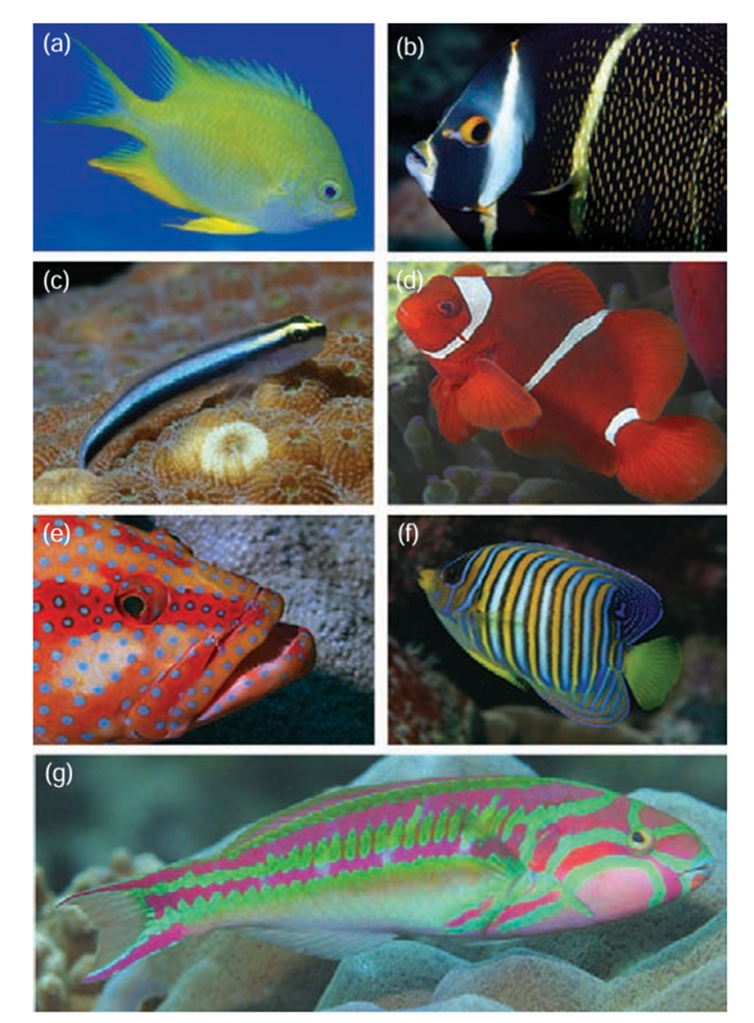
Figure 1. Diversity of colors and shapes in reef fish. (a) Golden damselfish Amblyglyphidodon aureus. (b) French angelfish Pomacanthus paru. (c) Cleaner goby Elacatinus evelynae. (d) Clownfish Premnas biaculeatus. (e) Grouper Cephalopholis miniata. (f) Angelfish Pygoplites diacanthus. (g) Five-stripe wrasse Thalassoma quinquevittatum (Figure: Marshall and Cheney, 2011)
What Colors Do Fish See?
Most reef fish swim at different depths in the water column, live among different reef structures, and experience varying levels of water clarity. This has led to the evolution of specific visual adaptations and signaling systems.
Reef fish generally lack sharp long-distance vision (it can be up to ten times worse than human vision), but they show great diversity in color detection. Some species are dichromatic, meaning they have only two types of cone cells or color channels, which makes it difficult for them to detect red and green wavelengths. Others are trichromatic, and some are even tetrachromatic. These differences are often linked to the depth at which they live and whether they are active during the day or at twilight. Therefore, it is possible that deep-sea fish may only have two cones and that reef fish may have up to four, but this is still under investigation.
Blue and Yellow: Staying Under the Radar
The use of blue and yellow is very common in reef fish and is closely linked to both camouflage and communication. One main explanation is that these colors are complementary—they strongly contrast with each other—while still allowing easy detection of spectral changes in the marine environment.
This type of coloration is especially common in the damselfish family (Pomacentridae), whose species are often entirely blue, greenish-blue, or yellow. This allows them to either stand out against yellow-brown corals or blend into the blue background of the water, depending on the dominant color, helping with communication or rapid camouflage (Figure 2a).
Larger species, such as angelfish (Pomacanthidae) and surgeonfish (Acanthuridae), use stripes or blocks of blue and yellow. Up close, these patterns function as aggressive or sexual signals. From farther away—keeping in mind the limited long-distance vision of reef fish—the details blur, and because these colors are complementary, a phenomenon known as additive color mixing occurs, resulting in a dull gray tone that helps the fish blend in (Figure 2b).
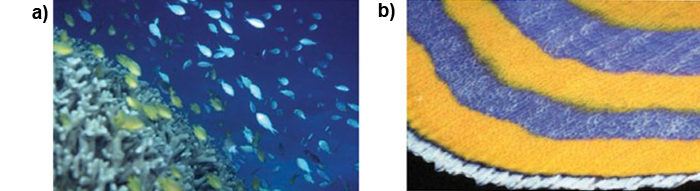
Figure 2. (a) Photograph showing how coloration allows fish to blend into their surroundings. (b) This anal fin on a P. diacanthus is an example of utilizing complementary colors (Images: Marshall and Cheney, 2011)
Pointillism: Another Camouflage Strategy
Another example of complementary colors is the use of green and pink, commonly seen in parrotfish (Scaridea) and wrasses (Labridae). These colors often appear as spots or dots that, when viewed from a distance, blend and resemble the blue-green background of the water. This form of camouflage is especially important for species that spend much of their time in the middle of the water column (Figure 3).
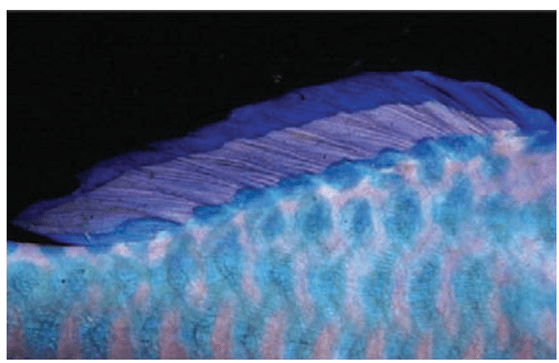
Figure 3. Color pattern found in parrotfish, where contrasting color patches are formed, helping with camouflage. (Image: Marshall and Cheney, 2011).
Cleaner Fish: Signals That Attract Clients
There is a group of fish known as cleaner fish, usually belonging to wrasses or gobies. These small fish provide a cleaning service by removing parasites from the skin, teeth, and gills of other fish. To do this, they establish cleaning stations on the reef and need to “advertise” their service (Figura 4b).
They do so mainly through specific movements, but color may also play a role. Most cleaner fish are blue or yellow with horizontal stripes, and at least one of these stripes is often black. This black stripe increases contrast, making the fish easier to recognize (Figure 4a).
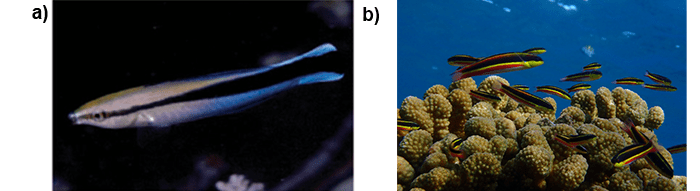
Figure 4. (a) Coloration of the cleaner fish Labroides dimidiatus. (b) Cleaner fish Thalassoma lucassanum, where the black stripe helps with identification. (Image a: Marshall and Cheney, 2011; Image b: Héctor Alejandro Hernández Castellanos).
The Best-Kept Secret: UV Communication!
Around half of reef fish species can see ultraviolet light, thanks to cone cells sensitive to wavelengths between 300 and 400 nm. This allows them to use a form of private or hidden communication, based on patterns that are only visible to species with UV sensitivity. This is a major advantage, as many large predators lack UV vision.
Studies have also shown that these UV patterns are often used for sexual selection and for defense or competition between males.
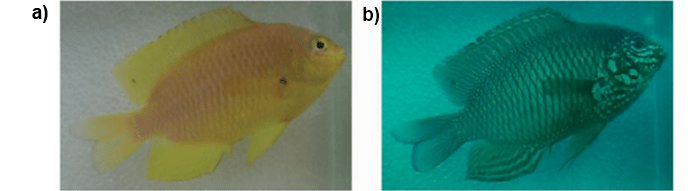
Figure 5. UV colors in damselfish become visible when photographed with a UV-sensitive camera (350–400 nm). (a) Ambon damselfish P. ambionensis, as seen by humans or by fish without UV sensitivity. (b) The same fish was photographed with a UV-sensitive camera, revealing a pattern of UV-reflective colors. (Image: Marshall and Cheney, 2011).
A Field That Still Needs Exploration
Due to the great diversity of cone mechanisms and visual systems in reef fish, our understanding of their visual ecology is still incomplete. For now, only general trends and isolated observations can be described. Many questions remain, especially regarding crepuscular and nocturnal species, as well as how vision functions across different fish groups.
Read the full article here: Marshall, N. J., & Cheney, K. (2011). Color Vision and Color Communication in Reef Fish. Encyclopedia of Fish Physiology, 1, 150–158. https://doi.org/10.1016/B978-0-12-374553-8.00095-2
Cover photo by Héctor Alejandro Hernández Castellanos
Glossary
Color: A visual perception created by the brain to interpret different wavelengths of light. This mainly depends on the structure of our visual system [1].
Visual ecology: A field that links the physics of light and color in an environment with the visual system and signaling strategies that have evolved there. It also examines vision-driven behaviors, not only from the observer’s perspective, but also at the scale of the species being studied [2].
Absorption: A process in which the ocean and its components (particles, organic matter) capture the energy of sunlight. As light travels down the water column, it becomes weaker, affecting visibility and photosynthesis. Colors like red and orange are absorbed faster than blue [2].
Scattering: A light phenomenon that occurs when particles in a medium such as air or water deflect light, separating it into its component colors [2].
Wavelength: The distance between one wave and the next, which indicates how much energy a type of radiation has. In the electromagnetic spectrum, infrared light has longer wavelengths and less energy, while ultraviolet light has shorter wavelengths and more energy. Both are outside the visible rainbow [2].
Spectrum: The visible region of the electromagnetic spectrum. The electromagnetic spectrum includes all types of light and energy that travel through space, from radio waves to X-rays, which differ in the amount of energy they carry [2].
Cone cells: Cone-shaped cells in the eye that work best under bright light conditions and are responsible for color perception [3].
References
[1] Royal Spanish Academy. Dictionary of the Spanish Language, 23rd ed., n.d. https://dle.rae.es/contenido/cita (accessed January 15, 2026).
[2] P. Tippens. Physics: Concepts and Applications, 7th ed., McGraw-Hill/Interamericana, 2011.
[3] N. J. Marshall, K. Cheney. Color Vision and Color Communication in Reef Fish. Encyclopedia of Fish Physiology, 1 (2011) 150–158. https://doi.org/10.1016/B978-0-12-374553-8.00095-2
 Reefbites