
Written by Thomás Banha
In the last few years, we have seen an increase in the arrival and expansion of non-native marine species in Brazil, and this year, a new Damselfish from the Indo-Pacific has arrived. The study describing this process gathered clues on how it occurred and what this can mean to the local species.
An unusual fish
In November 2024, Professor Marcelo Melo from the Oceanographic Institute of the University of São Paulo (IOUSP) returned from a recreational dive at the Queimada Grande Island, off São Paulo, Brazil, with pictures of an unfamiliar fish. Later, reviewing the images, he realized this was not a local species but Neopomacentrus cyanomos, the Regal Damselfish. A few weeks later, it was spotted in other parts of São Paulo by different divers, including Professor Miguel Mies, also from IOUSP and co-author of the work reporting the discovery. Although at different times, the record had the same outcome. “It was completely unexpected,” says Mies. “Three independent observations, one each month, all confirmed with photos and videos.” But the Damselfish was not a stranger to the Atlantic.
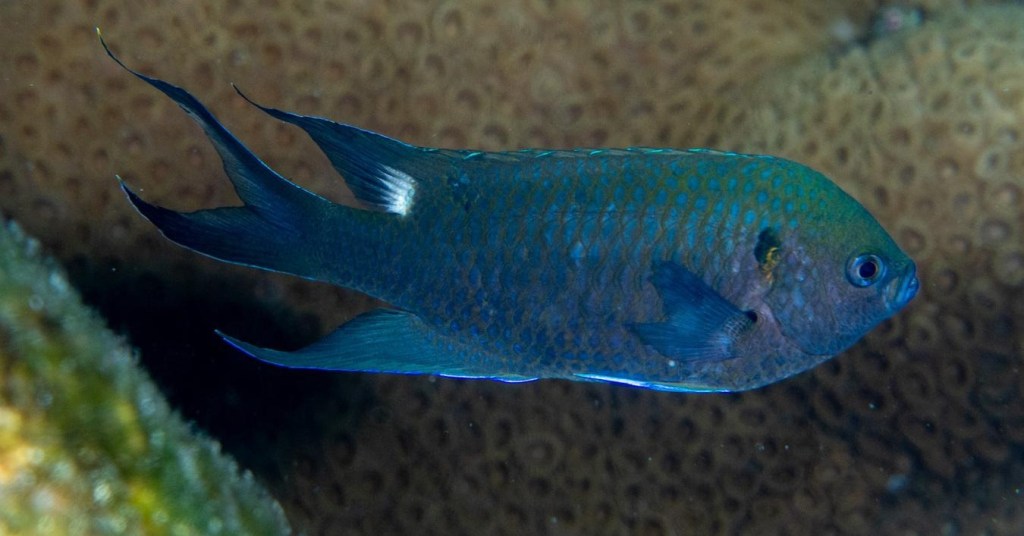
Photography of the non-native damselfish Neopomacentrus cyanomos (Regal Demoiselle) at Laje de Santos, southern Brazil. Photo credit: Luiz A. Rocha.
Experienced traveler
In mid-2013, N. cyanomos was first observed in the Atlantic, when more than 130 individuals were recorded during underwater visual censuses in Veracruz, Mexico. The species was the first non-native pomacentrid recorded in the Gulf of Mexico (GoM), and, at the time, the authors expected negative impacts on the local biodiversity, impacting fisheries and ecosystem health. Within just a few years, the species spread and can now be found throughout the GoM. And now, a decade later, it is an unsolicited visitor to Brazilian waters.
But how?
How did this tiny reef fish reach Brazil? The researchers raised four hypotheses to explain: aquarium trade, ballast water from ships, natural migration, and transport on oil platforms. Only the last one stood out. Oil rigs often serve as floating reefs, covered in marine life. When towed between oceans, they can carry many organisms, including adult fish, eggs, or larvae clinging to submerged structures. As such, this can introduce invasive species into Brazil, such as the sun corals from the genus Tubastraea. “That’s the most likely explanation,” says Mies. “It’s already been proven as the introduction pathway in the Caribbean, and these sightings are close to Brazil’s busiest oil fields.”
Possible threat
So far, only a few individuals have been found, but the species reproduces quickly, and Mies suspects it may expand northward, potentially harming local fauna. “The species has the potential to be invasive, and we are probably seeing the beginning of this invasion,” he says. To avoid this, he proposes some tools to contain this process. “What we can do is strengthen regulations, inspect oil platform movements, control ballast water, and maintain long-term monitoring.” But Mies warns, “Stopping it, however, is a challenge.”
This invasion reminds us that the ocean is deeply connected. With ships and oil platforms linking distant seas, new species can appear when least expected. Careful monitoring and early action are our best responses to protect local reefs. The damselfish joins the lionfish and the sun coral as a non-native species, both of which are already affecting the Brazilian marine environment. Let’s hope this tiny fish does not cause as much trouble as its peers.
References
González-Gándara C, De la Cruz-Francisco V (2014) Unusual record of the Indo-Pacific pomacentrid Neopomacentrus cyanomos (Bleeker, 1856) on coral reefs of the Gulf of Mexico. BioInvasions Records 3(1): 49-52.
Melo MR et al. (2025). First records of Neopomacentrus cyanomos (Bleeker, 1856)( Pomacentridae, Blenniiformes) in Southwestern Atlantic reefs. Check List 21(5):909-916.
Robertson DR et al. (2018) An Indo-Pacific damselfish (Neopomacentrus cyanomos) in the Gulf of Mexico: origin and mode of introduction. PeerJ 6: e4328.
 Reefbites