
By Rebecca Gibbel DVM
Dan Mele is an underwater science photographer and filmmaker who is based in the U.S . Virgin Islands. In addition to his own photography business, he works as the media specialist at the University of the Virgin Islands (UVI). Dan has managed the land-based coral nursery at the UVI, developing innovative coral propagation techniques and researching restoration approaches for threatened coral species.
Photography is such a combination of art and science, and marine scientists like you seem to possess deep curiosity and a passion for their subject. Which discipline came first for you, or did they evolve together?
My fascination with nature began from a very young age. We had a drainage ditch across from my parents’ house, which had a flowing stream with frogs and crayfish. This was my Serengeti. In middle school I took my first photography class, and shortly after got into making short videos of me and my friends skateboarding. Initially, my passion for image making and nature evolved separately and it wasn’t until my mid-20’s when I realized I could combine these passions.
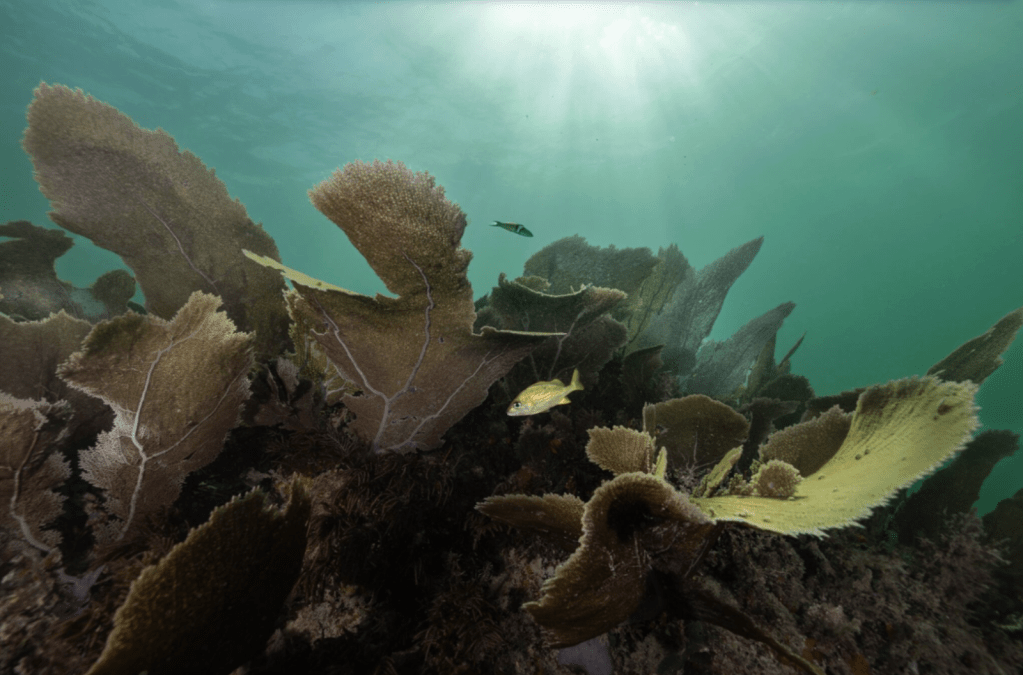
Caribbean sea fans (Gorgonia ventalina). Photo by Dan Mele.
Have you encountered any difficulty when trying to capture images while also working or collecting data? Or do you need to keep your photography work separate from your coral restoration work?
When I was working as a scientist and photographer/filmmaker, it was extremely challenging to do both at the same time. The research part always came first, so I would need to factor in extra time for documenting or bring extra people to help with research so I could have more time for shooting. My mindset for doing research and creating images is completely different, so the hardest part was switching between those modes to be able to create a compelling image.
Your TEDx talk was a mesmerizing presentation of your marine photography, showcasing the weird beauty of corals. Are there special considerations for photographing these strange animals?
I’ve been fascinated with images of coral reefs for as long as I can remember, but as I started working with corals as a researcher, I realized that most coral reef photos rarely do justice for the coral animal. Usually, the coral animal is secondary to whatever the primary subject is: a school of fish, turtle, shark, etc. The focus of my TEDx talk was to highlight my journey in creating a set of portraits of Caribbean coral species where the coral is the sole focus of the image and removing all other distractions.
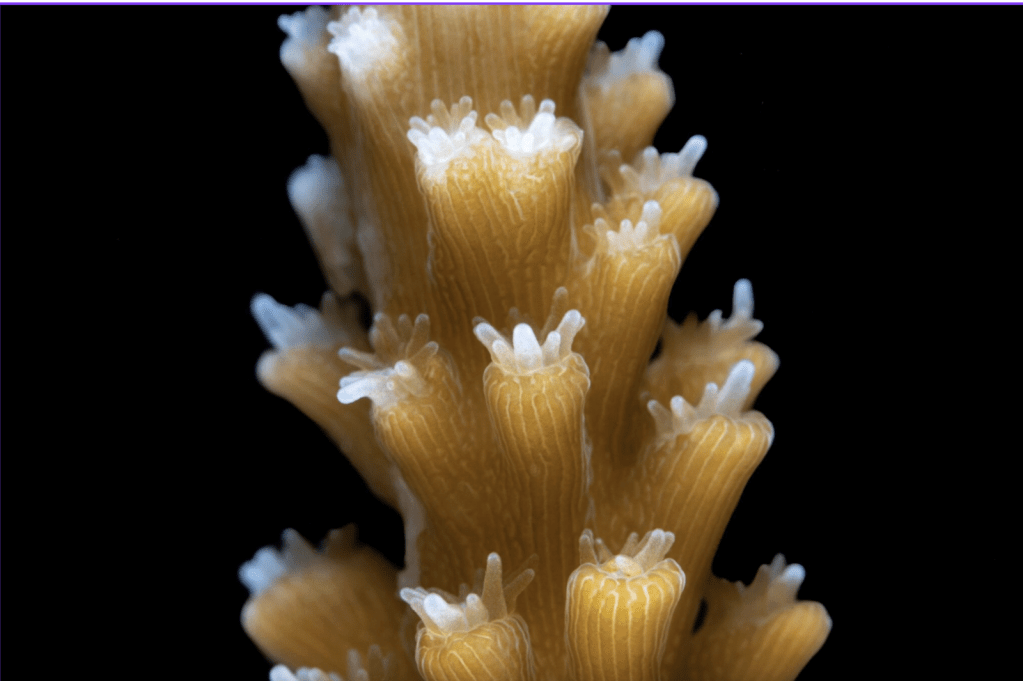
Portrait of an Acropora cervicornis coral with polyps extended. Photo by Dan Mele.
With such an immense amount of incredible wildlife photography available at no cost on the internet, it must be quite challenging to make a living from your work. But it sounds as if you have leveraged your coral restoration work experience and connections into an academic communications job in the Virgin Islands that provides a steady income. How did you get to this point?
There’s no clear roadmap for making a living as a conservation photographer/filmmaker. For my journey, my background in science had a huge impact on where I am today, but it doesn’t mean you need a background in science to do this work. The best early advice I was given is to diversify my sources of income. Relying only on assignments is challenging, but since I have a combination of print sales, stock imagery, publications, short films, and more recently teaching workshops, I’ve found that making a living in this field is possible. Additionally, I do take on non-conservation work as well when I can fit it in.
Do you have any photographic advice for newbies trying to photograph fish or corals with basic underwater cameras?
Don’t get too caught up in fancy gear until you know you are ready to pursue this long-term. Most importantly you need to know whatever camera you have inside and out. Until you understand every function in your current camera, you haven’t maxed out its capabilities. Learning composition is something everyone should focus on early on. You can apply this to literally any camera you have and it will have a huge impact on creating aesthetically pleasing images.
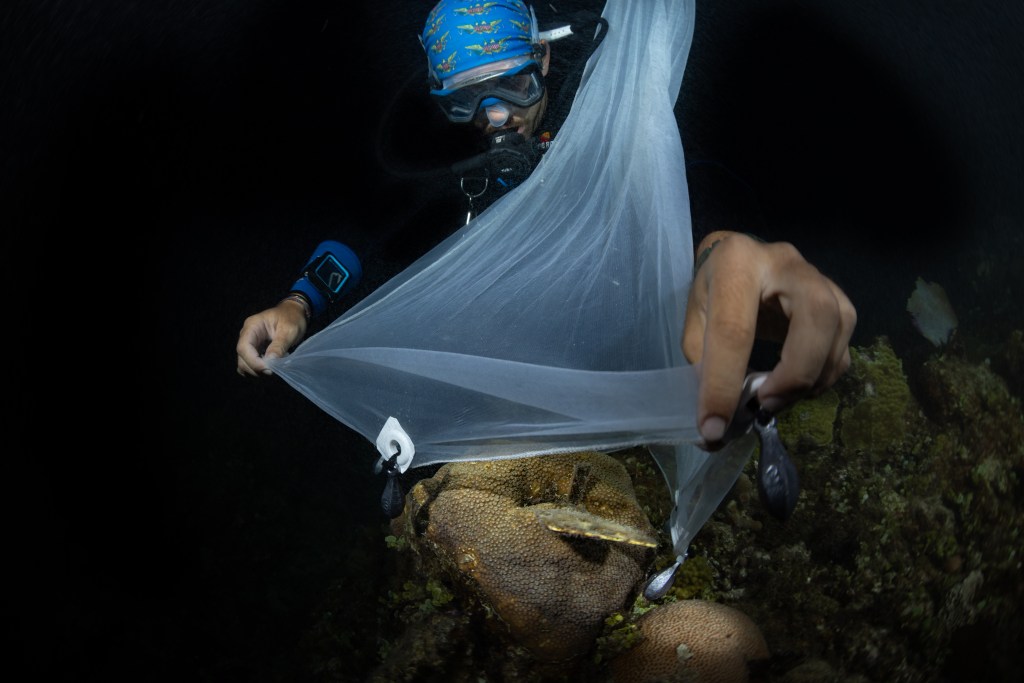
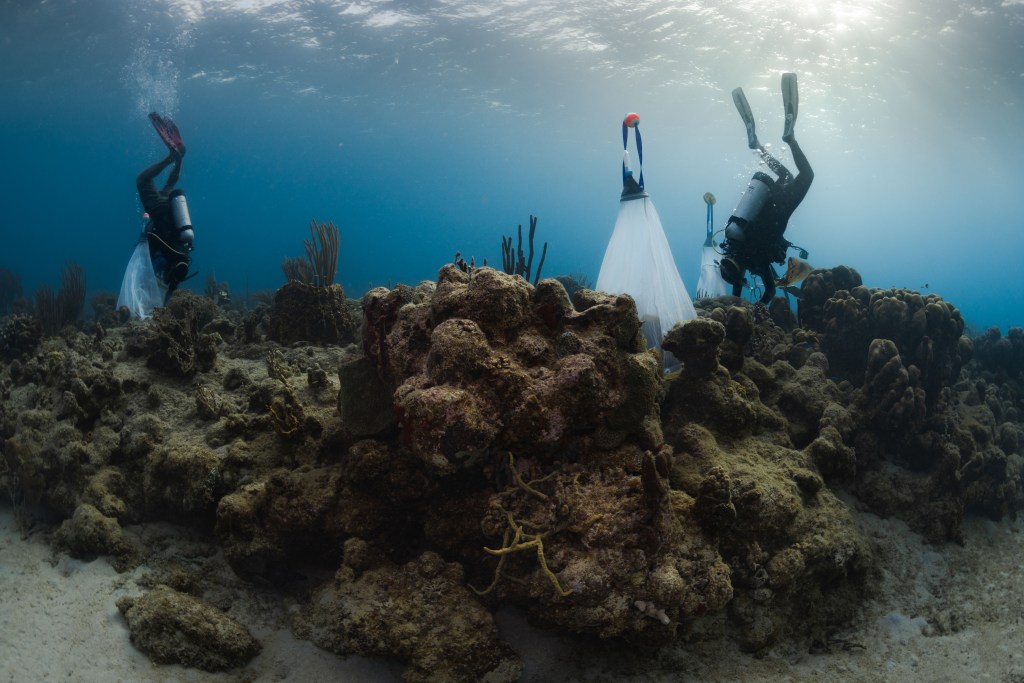
Placement of underwater nets to collect gametes during coral spawning. Photos by Dan Mele.
You seem to have such an easygoing nature, but it’s obvious that you’ve accomplished a great deal. Do you have an intense side to your personality? If so, what drives you the most?
My drive comes from a combination of several factors. Working with scientists who are so dedicated to improving the world inspires me to try and tell the best story possible about their work. On the image-making side, I believe being a photographer/filmmaker is a field where you never truly “make it” but instead you just keep improving. I’m a slow learner, so this process can be a challenge for me but as long as I make a few steps each day, that gives me the motivation to keep pushing myself.
What’s next for you? Any special projects on your horizon?
I’m currently working on getting a few stories published that I’ve been documenting over the last few years so keep an eye out for those! For 2026, my goal is to focus on documenting freshwater habitats in the U.S. Virgin Islands. We have such little freshwater but there are tons of interesting animals that live in the seasonal streams or “guts” that carve through our watersheds. There are a few researchers who are studying these habitats but to my knowledge, no one has ever photographed them outside of scientific documentation purposes. So, I’d love to shed light on this part of the Virgin Islands that most people don’t even know exist.
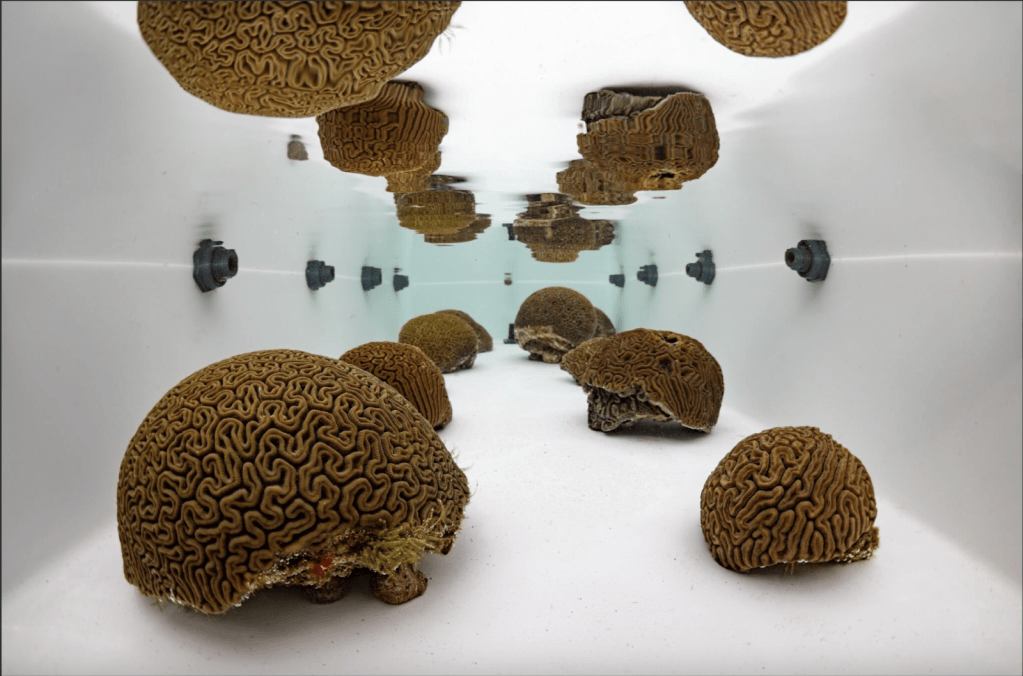
Diploria labyrinthiformis corals in a research tank at the University of the Virgin Islands. Photo by Dan Mele.
These are hard times for coral reefs, with their deterioration stemming from anthropogenic pressures, including climate change. How do you stay positive, or do you actually stay positive?
I go through waves of positivity and sadness when I think about coral reefs and what they’ll look like 20-30 years from now, but my work is not only about documenting environmental problems, but also conservation success stories. Seeing how the coral restoration/research field has immensely grown over the last decade keeps me positive because we have so many more heads in the game trying to find solutions.
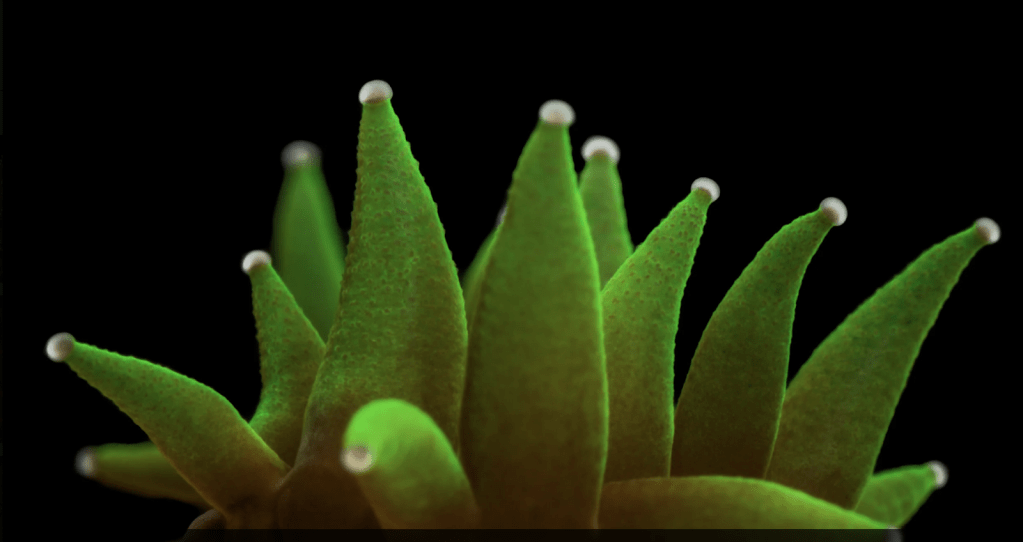
An image of a single polyp of Dendrogyra cylindrus. Photo by Dan Mele from http://www.danmelephotography.com.
 Reefbites