
By Dr. Rebecca Gibbel
Coral reefs and whales are interconnected, with benefits flowing in both directions. Baleen whales like humpbacks and right whales rely on reefs which provide habitat for the schools of small fish and krill that the whales consume. Humpbacks (Megaptera novaeangliae) travel to reef-protected shallow areas to give birth, where their calves will be protected from predators and ocean currents. And the complex three-dimensional structure of coral reefs create soundscapes that whales depend on for navigational cues as they migrate through an ocean with limited landmarks.
In return, whales help coral reefs by providing inputs of their nutrient-rich waste and by stirring up ocean sediments which releases iron and nitrogen into the water column. These actions stimulate the growth of the phytoplankton and zooplankton that are at the base of the food web in the reef ecosystem. And as predators of small fish, whales keep populations in balance on the reef so that biodiversity is maintained.
THREATS TO WHALES FROM HUMAN INFLUENCE
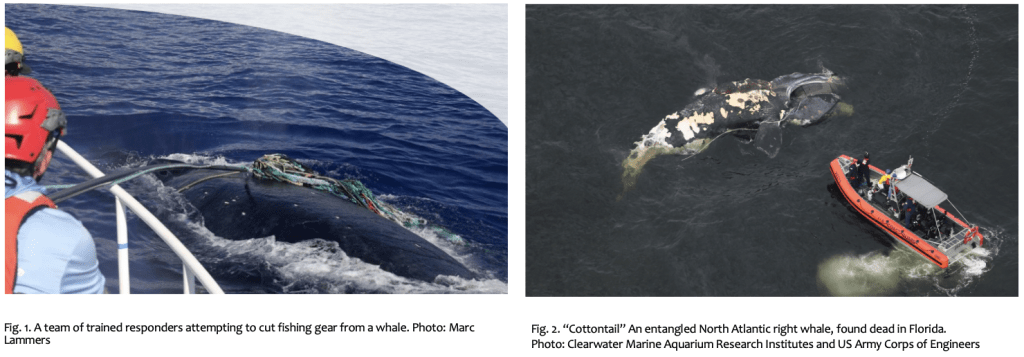
Whales have been on earth for over 50 million years [1], far longer than the mere 300,000 years for Homo sapiens [2]. Humans have been hunting whales for over a millennium, but in the past few centuries whales have been nearly driven to extinction by humans’ insatiable demand for whale oil and meat. Fleets of whaling ships with harpoons scoured the oceans until global bans on whaling were enacted in the mid-20th century. Japan, Norway, Iceland, Greenland and the Faroe Islands unfortunately still continue to hunt whales for meat, as do North American indigenous people. Commercial whale hunting is now done with harpoons containing explosives, causing a brutal death in about six minutes. Despite numerous anthropogenic pressures like chemical and sound pollution and increasingly frequent impacts from large shipping vessels, whale populations inched upward after the whaling bans were enacted. However, the current threat of ubiquitous fishing lines in the ocean now pose an enormous danger to all whales, creating entanglement hazards that are ubiquitous. Rope entrapments typically start when a whale has snagged a long rope, which is frequently a stationary vertical line connecting a surface buoy to a benthic trap for lobsters or fish. The entangled lines typically cut deep into skin and muscle, often leading to a protracted and painful death that makes hunting with explosive harpoons seem almost humane in comparison. The strangulation wounds cause suffering over many months or years and interfere with movement and reproduction. As Michael J. Moore writes in his book, “We Are All Whalers,” [6] anyone who consumes wild caught seafood can be considered an indirect cause of this massive unintentional killing, as upsetting as that notion may be. The magnitude of this threat is severe, with 70 % of diagnosed mortalities of right whales [3] being due to entanglement with fixed fishing lines, abandoned nets and gear.
CAN’T THEY JUST BE CUT FREE?
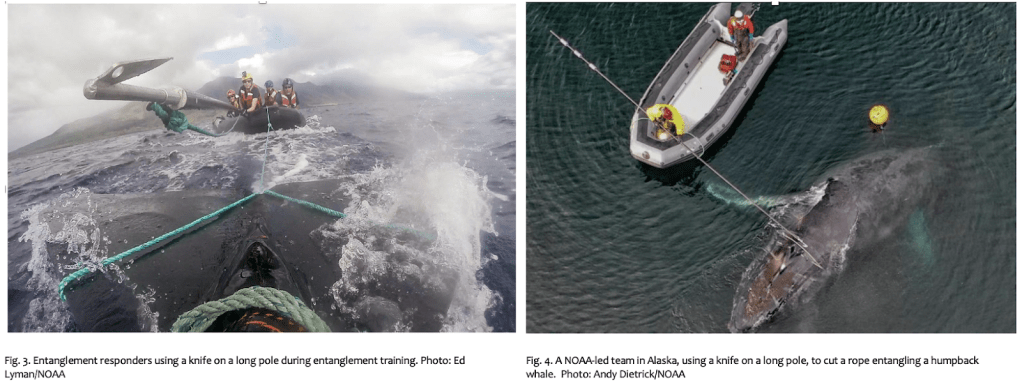
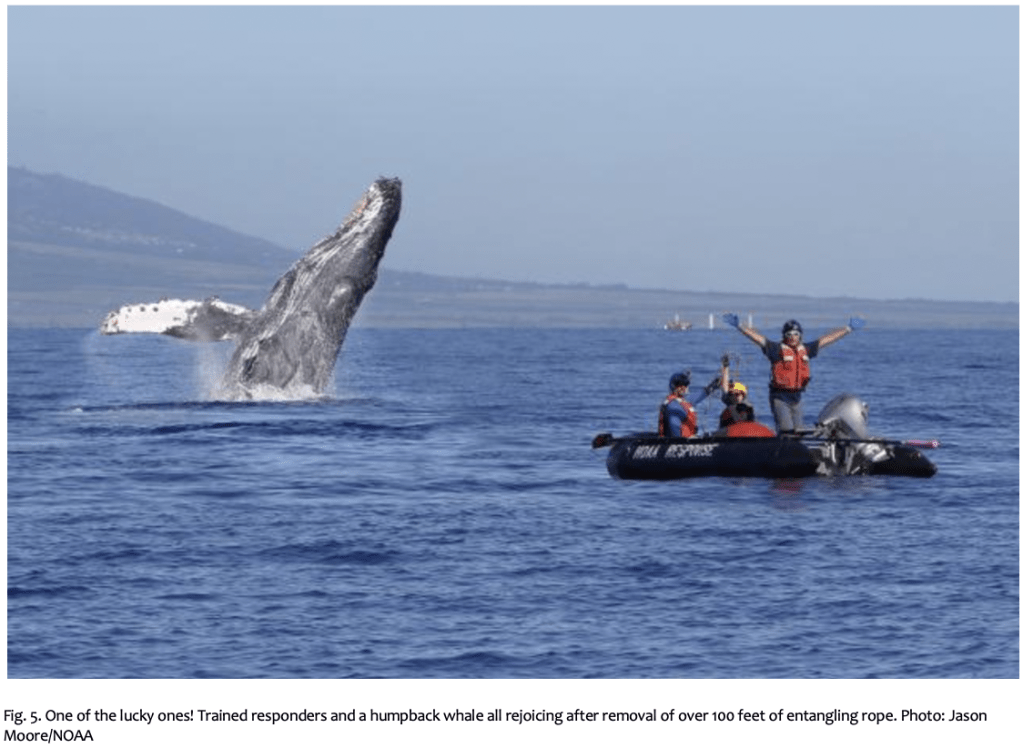
The National Marine Fisheries Service is an office of the National Oceanic and Atmospheric Administration (NOAA) within the Department of Commerce. It is responsible for training and certifying the nationwide network of whale disentanglement responders and mounting response operations when a large whale is reported as ensnared. This is very dangerous work that requires extensive training since entangled whales are huge marine animals in distress, and they can dive deep and crush or pull a would-be savior underwater. Even highly skilled responders can be endangered when they pull on an entangled rope that has painfully embedded itself in a whale’s body. Responders attempt to float the whale at the surface using techniques from whaling days, while employing sharp knives on long poles from an unstable watercraft. If citizens witness an entangled whale, they should report the situation to NOAA but not attempt to remove the lines themselves. The prospects for a successful outcome aren’t very good, even with concerted efforts by responders. Most likely the vast majority of whales that are lethally entangled drown and die in the deep ocean where they spend most of their time. From statistics in 2022, of the large whales that are noticed to be entangled near shore, only 13% were able to be fully disentangled by rescue operations [4]. It’s far better to prevent these terrible situations, than to try to correct them after they’ve developed.
ALTERNATIVES FOR REDUCING BYCATCH
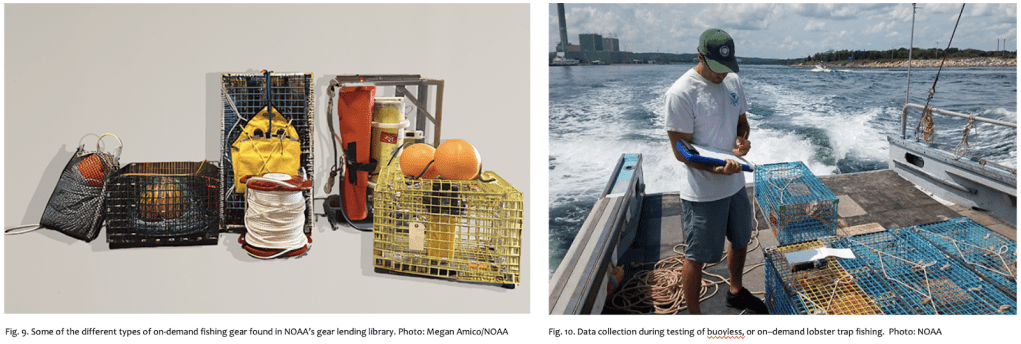
Of course no lobster or crab fisher wants to kill whales. They usually do not ever see the whale or turtle that becomes entangled by their own gear, but they are aware of how much “bycatch” occurs from fishing. This term refers to the capture of unintended species that usually die along with the intended targets. Bycatch ranges from the thousands of albatrosses impaled on long line tuna hooks, to turtles drowned in fish nets, to whales dying from entanglement from vertical fishing lines and other fishing gear. But there are alternatives, and several are seen in the figure below from NOAA Fisheries. “On-demand”, or ropeless fishing for lobsters and crabs, is an extremely successful alternative to the traditional method of using fixed ropes to connect a surface buoys to traps or nets on the ocean bottom, which may remain in place for weeks. Usually, these on-demand methods employ an inflatable air bladder that is activated by an acoustic signal from the fisher when it is time to lift the trap to the surface.
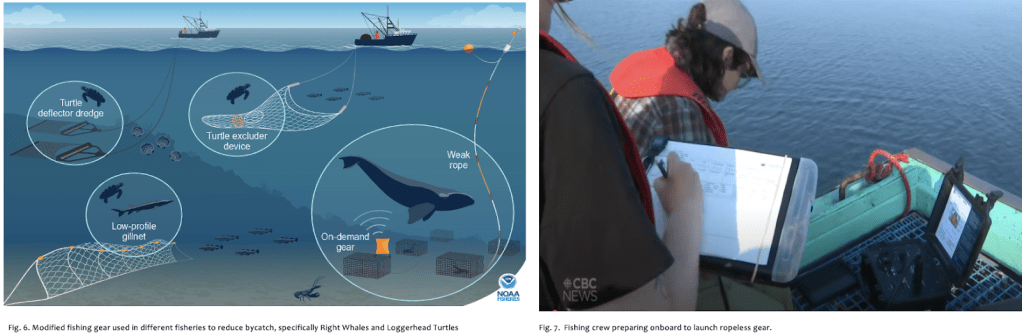
In addition to the satisfaction of helping the marine environment upon which we all depend, there is a strong financial motivation for fishers to use the new technology. Large areas of federal waters in the Atlantic are seasonally closed to fishing with static vertical lines during whale migrations. But fishers who are registered users of on-demand fishing gear are provided with an exemption because their methods do not present entanglement risks. This allows them to access rich fishing grounds that would otherwise be closed to them. NOAA has collaborated with fishers across five states and three fisheries to develop these systems. Since the fishers alone control their gear, poachers are no longer able to take their submerged traps. Ropeless systems result in less time locating and hauling traps to the surface, while minimizing the risk of injury to the crew. Overall, the management of the fisheries that employ the technology is improved.
DETAILS PLEASE!
Fishers who wish to take advantage of fishing permit exemptions and reduce harm to marine life can explore the new technology at no cost by borrowing gear from NOAA’s “lending library” of ropeless systems. This allows them to become familiar with the different options by testing them in real life situations and to provide feedback that helps in the development of the new technology. This library houses hundreds of different ropeless fishing systems that have been donated by the government as well as environmental organizations. As seen in the photo below, alternative gear includes pop-up buoys, inflatable lift bags and buoyant spools that bring the traps to the surface and further details may be seen here.
CASE STUDY: NORTH ATLANTIC RIGHT WHALES
North Atlantic right whales are among the most endangered animals on earth. Originally numbering between 9,000 and 21,000 [8], they are now down to a population of only 356 individuals, according to the North Atlantic Right Whale Consortium’s count in 2023. Of these, only about 70 are females of breeding age [7], so the species is now approaching extinction. They were heavily hunted during the most intense years of whaling, with thousands killed in the 1600’s [8], and were named the “right whale” because they were considered the right whale to kill. Their oil-rich bodies float after being harpooned, which was a major advantage for the butchering process. Now they are not being targeted for killing, but their ranges overlap with fishing areas in the North Atlantic, where growing numbers are being killed by entanglement with stationary lobster and crab fishing lines. According to WHOI’s Ropeless.org [9], more than 86% of these whales have been entangled at least once. In the past 15 years, nearly 20% of the entire NARW population has been killed by US fisheries [9], which is called an “unusual mortality event”. But it is not unusual if you consider that whales did not evolve to avoid the great proliferation of fixed lobster trap lines blocking their movements through the ocean. It is clearly well past time that something must change. Ropeless fishing systems have the potential to stop the suffering of these awe-inspiring animals and help prevent their extinction, and fishers do not even need to sacrifice profits. Continued investment by the government and private sector is urgently required to promote further adoption of on-demand systems, and the development of training programs in their use. Human ingenuity has found a way to harvest lobsters from the bottom of the ocean to feed our desire for consuming this luxury seafood. And people have also invented a solution for the horrific collateral damage we have caused, if we will only adopt it in time.
————————————–
CITATIONS
[1] Forest, A. (2021, September 2). The Origin of Whales (evolution), Baleines En Direct.org. https://baleinesendirect.org/en/discover/life-of-whales/morphology/les-ancetres-des-baleines/#:~:text=The%20first%20whales%20appeared%2050,land%20mammal%2C%20adapted%20for%20running.
[2] Human, Wikipedia, https://en.wikipedia.org/wiki/Human#:~:text=Humans%20are%20apes%20(superfamily%20Hominoidea,24%20for%20the%20other%20apes.
[3] Kershaw, F. Experts Advise Administration on Right Whale Entanglement. NRDC.org, https://www.nrdc.org/bio/francine-kershaw/experts-advise-administration-right-whale-entanglement
[4] National Report on Large Whale Entanglements Confirmed in the United States in 2022, National Marine Fisheries Service,
[6] Moore, M. J. (2021). We are all whalers: The plight of whales and our responsibility. In We Are All Whalers. University of Chicago Press.
[7] North Atlantic Right Whale Calving Season, NOAA.gov, https://www.fisheries.noaa.gov/national/endangered-species-conservation/north-atlantic-right-whale-calving-season-2025
[8] How Right Whales Got Their Name, IFAW.org, https://www.ifaw.org/international/journal/how-right-whales-got-their-name#:~:text=Prior%20to%20whaling%2C%20experts%20estimate,whalers%20hunted
[9] Ropeless Consortium – Towards whales without rope entanglements. Woods Hole Oceanographic Institution, https://ropeless.org/
General references:
https://coral.org/en/blog/whales-coral-reefs-and-the-future-of-our-oceans/ the Coral Reef Alliance
NOAA”s ON DEMAND GEAR GUIDE: https://repository.library.noaa.gov/view/noaa/66864
 Reefbites