
Written by Jasmine Haskell
Climate change is one of the greatest challenges we face as a global community. The release of excessive greenhouse gases from human activities such as, combustion of fossil fuels, agriculture and deforestation intensifies the natural greenhouse effect, leading to a rise in global temperatures that drives a host of environmental disruptions (IPCC, 2023).The greenhouse gas effect is the process by which certain gases in the Earth’s atmosphere trap the heat from the sun by preventing its escape back into space. A predominant and much discussed greenhouse gas is carbon dioxide as it has the longest atmospheric lifetime out of the other greenhouse gases (100-10,000 years) (IPCC, 2014). Our world’s oceans have captured about 25% of these human sourced carbon dioxide emissions, which causes ocean acidification, fluctuations in dissolved oxygen concentrations and changes in ocean circulation.
Summary of the greenhouse gas effect. Source: https://www.nps.gov/grba/learn/nature/what-is-climate-change.htm

With the growing urgency of climate change, researchers and community leaders worldwide have been exploring various strategies to tackle the issue. A promising avenue is the use of ocean-based carbon dioxide removal processes. These processes aim to utilise the ability of the ocean to absorb and store excess carbon dioxide through enhancements in already naturally-occurring processes.
One such process is known as carbon dioxide sequestration. This involves capturing the emissions from industrial processes and then injecting the carbon dioxide into deep ocean sediments at depths of 2800m. At this depth, carbon dioxide becomes denser than seawater which helps prevent the carbon dioxide being released back into the atmosphere. Carbon dioxide is naturally transported to ocean depths through sinking phytoplankton cells, zooplankton faecal pellets and through active transport by zooplankton and fish. Without these naturally occurring processes, atmospheric carbon dioxide concentrations would be 50% higher than current values.
Ocean alkalinity enhancement is another ocean-based carbon dioxide removal process that shows promise. This process involves increasing the alkalinity of seawater which helps to enhance its natural ability to absorb and store carbon dioxide. By adding alkaline substances such as calcium or magnesium hydroxide to the ocean, the pH levels can be increased, allowing for greater carbon dioxide uptake from the atmosphere. Another method of increasing the alkalinity of the ocean is through a technique known as bipolar membrane electrodialysis (BMED), where seawater is passed through an electrical membrane to remove excess acidity. Both of these mechanisms enable for higher removal rates of atmospheric carbon dioxide while simultaneously mitigating the effects of ocean acidification.
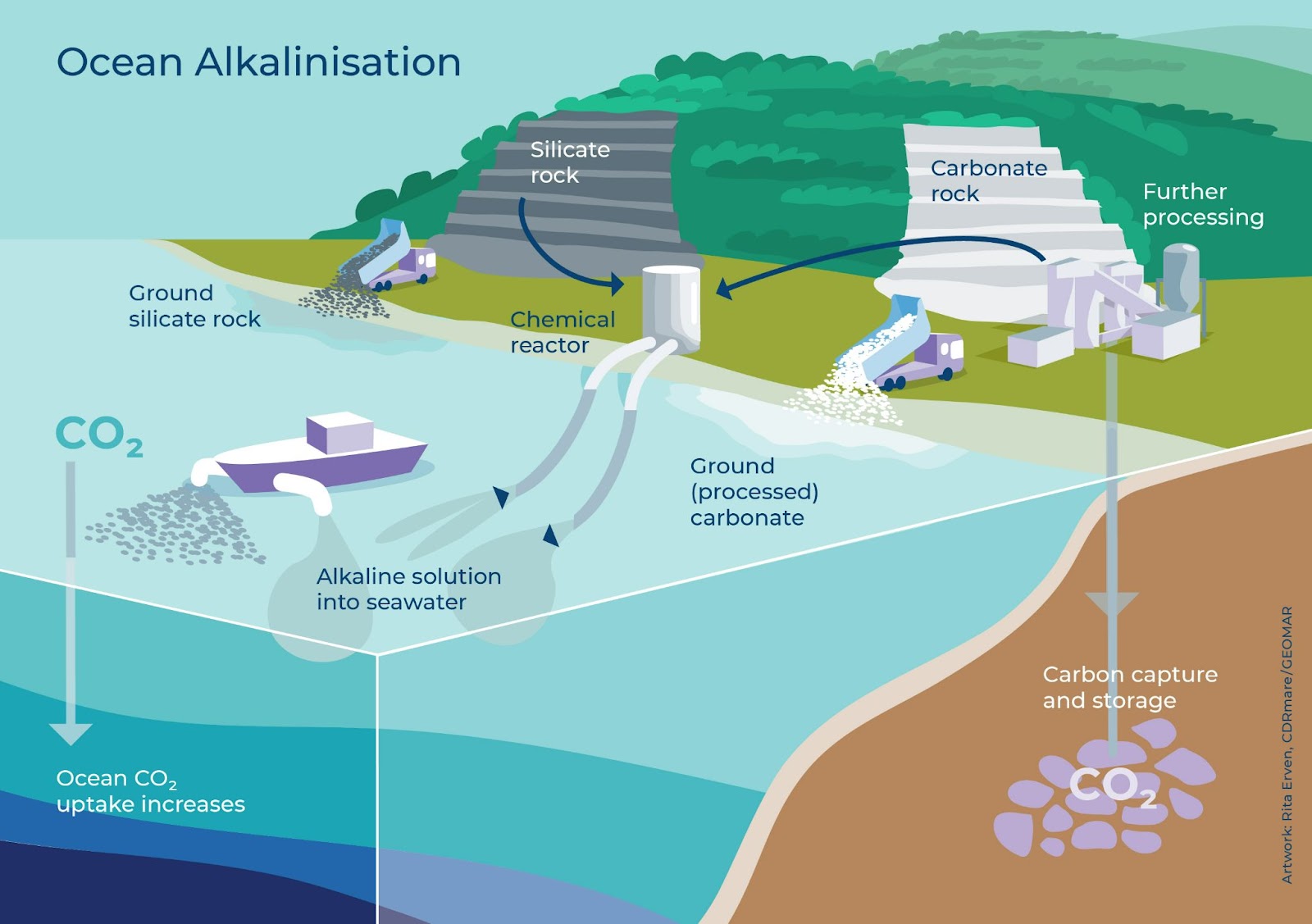
Summary of different ways of adding alkalinity into the ocean. Source: https://www.oceanblogs.org/oceanvoices/2022/08/15/rock-powder-against-climate-change/
Before implementing either of these ocean-based carbon dioxide removal processes on a larger scale, there are several considerations that need to be addressed. One major consideration is the impact on marine ecosystems. Ocean alkalinity enhancement has often come under scrutiny for this reason, akin to other geoengineering strategies, as it involves introducing an enormous surplus of minerals into the environment, some of which have unknown long-term consequences for marine life. The environmental impacts of long-term carbon dioxide storage in deep-ocean sediments also remains poorly understood, thus any large-scale intervention must prioritise the preservation of these systems. Another important consideration is the efficiency and effectiveness of carbon dioxide removal processes in the ocean. The amount of carbon dioxide that can be effectively removed and stored using these processes needs to be thoroughly studied and optimised, something of which many scientists are currently investigating. The cost effectiveness of these processes is also an important factor to consider, as large-scale implementation will require substantial investment and global interest.
Perhaps the most scalable and tangible method that is already being implemented worldwide is the cultivation of seaweed. As a photosynthetic organism, seaweed stores carbon in the form of sugars to help its growth.. When cultivated in large amounts,seaweed sequesters large amounts of carbon dioxide. Seaweed can go on to be harvested for use in pharmaceuticals, bioplastics and fertiliser or can be used to help restore marine habitats.
While there are many fantastic strategies emerging to help sequester carbon dioxide, the first and foremost priority should be to reduce carbon dioxide emissions. Ocean-based carbon capture strategies can only offer effective solutions if combined with significant efforts to reduce greenhouse gas emissions from human activities. If we all make small changes to our lifestyles as individuals, we can collectively help to reduce emissions. These actions can be as small as turning off lights when not in use, using public transport or carpooling when available or swapping out one meat-based meal to a plant-based meal a week. By combining new technologies with everyday choices, perhaps we can change the current trajectory.
References:
IPCC, 2023: Climate Change 2023: Synthesis Report. Contribution of Working Groups I, II and III to the Sixth Assessment Report of the Intergovernmental Panel on Climate Change [Core Writing Team, H. Lee and J. Romero (eds.)]. IPCC, Geneva, Switzerland, 184 pp., doi: 10.59327/IPCC/AR6-9789291691647.
Galen A McKinley, Val Bennington, Malte Meinshausen and Zebedee Nicholls (2023). Modern air-sea flux distributions reduce uncertainty in the future ocean carbon sink. Environ. Res. Lett. 18 044011. DOI 10.1088/1748-9326/acc195
Energy Fuels 2023, 37, 13, 8739–8764
 Reefbites