
Written by Carly E. Karrick
You’re probably familiar with tropical corals that form beautiful coral reefs teeming with life. While these corals live in warm, tropical water, other coral species that don’t form reefs live in colder water. These corals are called temperate corals, and they’re important for scientists to understand tropical coral biology. However, we didn’t know much about how things like light, depth, and algae influence them until recently.
Temperate corals can help us understand reef-building coral biology
Temperate corals like the northern star coral (Astrangia poculata) are used as model systems to study the biology of tropical, reef-building corals. They are especially useful to study a key partnership between coral and tiny algae (microalgae) that are necessary for reef-building corals to live and form reefs [1]. Unlike tropical corals, the northern star coral can live even if it doesn’t partner up with microalgae. So, some of these corals have microalgal partners (symbiotic corals), while others don’t (aposymbiotic) [2]. Although the northern star coral is very important to scientists studying coral reefs, we don’t know much about how different environmental conditions affect it. In 2023, scientists from the University of Rhode Island spent countless hours underwater trying to understand how light, depth, and macroalgae affect the northern star coral.
Temperate corals like the northern star coral live in cold water and don’t form reefs. They can live with microalgae (darker corals pictured above) or without microalgae (lighter corals pictured above).
How do light, depth, and macroalgae influence temperate corals?
Researchers counted the amount of macroalgae and northern star corals with and without microalgae in Rhode Island, USA. They did this at depths from 0-30 meters. They observed that the amount of light, macroalgae, and corals changed at different depths. Then, they performed statistical analyses to model how northern star corals are affected by light, depth, and macroalgae.
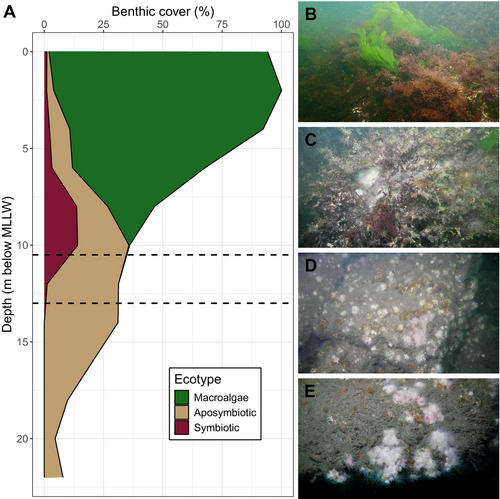
Scientists found that the abundance of macroalgae and northern star corals was different at different depths. In shallower water, macroalgae was most common, as shown by the green in the graph above. At mid-depths, northern star corals were more common and were found either with or without microalgae (red and tan in the graph above, respectively). At the deepest points, northern star corals were only found without microalgae (aposymbiotic).
Macroalgae compete with temperate corals
In this study, scientists found that both depth and light were related to the abundance of northern star corals. However, macroalgae abundance had the largest influence on coral abundance at shallow depths. Macroalgae negatively affect coral growth in several ways. They can prevent light from reaching corals, which is problematic for corals with microalgae that need light to make food. Macroalgae can also take up space, preventing corals from growing. The researchers who performed this study think that the negative influence of macroalgae on coral could drive the distribution of corals at different depths. In shallow water with more light that allows macroalgae to grow, coral is less abundant. In deeper water where macroalgae don’t grow, areas with more light have more coral.

Light, depth, and macroalgae affect northern star corals, but these effects change at different depths. At shallow depths, coral is less common in areas with more light and macroalgae. In deeper areas where macroalgae don’t grow, corals with microalgae are more common at mid-depths. In the deepest areas where corals are only found without microalgae, corals are more common when there’s more light.
Macroalgae-coral competition is getting more extreme
In addition to helping scientists understand where temperate corals grow, this study can be used to plan conservation efforts. For example, protecting deeper habitats where northern star corals thrive from destructive fishing practices could increase coral abundance. Also, one member of the research team that did this study, Willow Dunster, says that it’s important to understand how macroalgae and northern star corals interact because, “as oceans change, macroalgal cover will change.” Part of this change is runoff from things like wastewater that add nutrients to the ocean. More nutrients and warmer water allow macroalgae to grow faster, which can reduce the amount of both temperate [3] and tropical [4] coral. Going forward, we should consider ways to minimize the negative impacts we have on our ocean.
Read the full article here: Lindsay, T., Dunster, W., and Prada, C. (2025). Macroalgae and light availability modulate the distribution of the temperate coral Astrangia poculata. Marine Ecology, 46(1), e70001. https://doi.org/10.1111/maec.70001
References
[1] Baker, A.C. (2003). Flexibility and specificity in coral-algal symbiosis: diversity, ecology, and biogeography of Symbiodinium. Annual Review of Ecology, Evolution, and Systematics, 34, 661-689. https://doi.org/10.1146/annurev.ecolsys.34.011802.132417
[2] Dimond, J.L., and Carrington, E. (2008). Symbiosis regulation in a facultatively symbiotic temperate coral: zooxanthellae division and expulsion. Coral Reefs, 27(3), 601-604. https://doi.org/10.1007/s00338-008-0363-x
[3] Lindsay, T., Dunster, W., and Prada, C. (2025). Macroalgae and light availability modulate the distribution of the temperate coral Astrangia poculata. Marine Ecology, 46(1), e70001. https://doi.org/10.1111/maec.70001
[4] Ostrander, G.K., Armstrong, K.M., Knobbe, E.T., Gerace, D., and Scully, E.P. (2000). Rapid transition in the structure of a coral reef community: the effects of coral bleaching and physical disturbance. PNAS, 97(10), 5297-4302. https://doi.org/10.1073/pnas.090104897
[5] Featured Image – JAGO-Team, GEOMAR
 Reefbites