
By: Michelle Baptist
As a major phenomenon in both technology and conservation, artificial intelligence (AI) is found in virtually every online application. From the commonly used ChatGPT to more complex scientific benthic habitat modeling, the environmental impacts of AI are still being evaluated in modern society. AI’s emergence into coral conservation is one of particular interest, from both a professional and personal standpoint. Dr. Annalisa Bracco’s discussion on “Using Intuition and AI to Save Coral Reefs” during a TEDx Talk event in June 2024 was one that explained this paradox well. We often hear of using AI on its own in a more efficient way that can replace human activity entirely. However, Dr. Bracco provided a more in-depth perspective on the use of AI as a tool in relation to human intuition. Through Dr. Bracco’s presentation, scientific research on AI challenges, and my own experience working with coral AI models, there is much to consider when pairing AI with conservation.
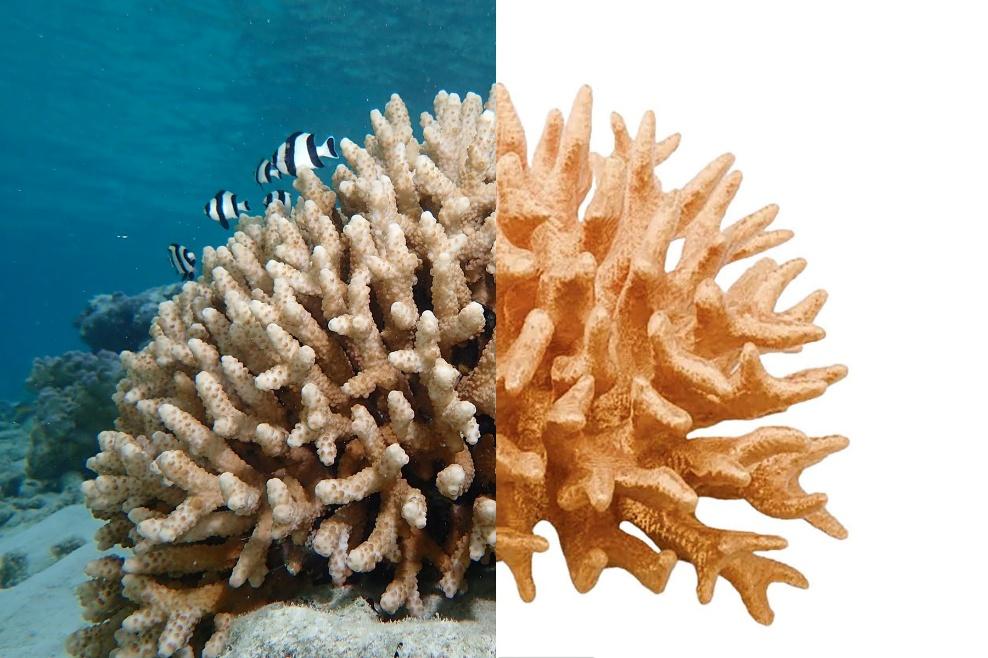
Figure 1. Image of a real coral reef (left) split with a coral reef-designed heat sink (right) to maximize cooling of high-performance AI chips. (Jared Pike via Purdue University.)
◆ AI Overview
At an early age, Dr. Bracco discovered her passion for the ocean after a sailing expedition off the coast of Italy. While studying physics in Georgia Tech in 2006, she found herself more interested in working with computers and fluidity modeling1. This led to the creation of her PhD project working with ocean eddies. An eddy is defined by NOAA as a swirling circular current of water that can cause nutrients normally found in colder, deeper waters to come to the surface2. Dr. Bracco began working more with coral reefs and computation modeling through a colleague’s project, which had been sampling deep water corals about 200 miles apart and 8,000 ft below sea level in the Gulf of Mexico1.
Surprisingly, her colleague’s genetic analysis samples had shown that these coral colonies had not exchanged any genetic information for over 10,000 years, despite being relatively nearby in the same Gulf region1. It opened Dr. Bracco’s eyes to the world of coral larval transportation using her own marine ecosystem connectivity research with eddies. Ocean currents and eddies influence how coral larvae are transported when the larvae try to find regions that are suitable for settlement. Once the larvae settle, there is a better chance of coral colony growth in a healthy habitat.
One of the main benefits of AI modeling is that it serves as a helpful tool, since genetic analysis is often expensive, timely, and requires a lot of labor. A few ways in which AI and machine learning (ML) are effective for creating new reef and ocean connectivity opportunities are:
- To ingest satellite data from the past 40 years to give us back a network of connectivity in different regions for the first time1.
- Showing coral researchers which reefs to prioritize to outplant fragments and where to pinpoint spatial strategies to keep corals alive for longer.
- Monitoring reefs as a system to check on coral stress regularly.

Figure 2. Dr. Bracco described her marine ecosystem connectivity research via TEDx Talk.
Another study by Dr. Abdullahi Chowdhury covers coral reef surveillance with AI, ML, geographic information systems (GIS), and remote sensing. These advanced surveillance methods for more effective monitoring are encouraged due to climate change, pollution, and human activities causing the rapid decline of coral reefs3,4. For example, my work with coral surveillance monitoring involved deploying underwater gliders that could cover 10 hectares (25 acres) and capture 50,000 high-resolution images per hour underwater5 to train AI models on Red Sea coral identification. This allowed for faster and safer surveying than scuba diving in strong currents along the heavily patrolled Saudi Arabian coastline.
Efficiency, but at what cost?
While AI is considered revolutionary technology, it is also important to note the technical challenges, ecological footprint and carbon emissions as limitations from its usage. High performance AI and ML models are not always accessible for remote research stations or easy to interpret with the use of “black boxes” in their applications3,4. Training and running AI models like ChatGPT consumes 1.287 gigawatt-hours of electricity, equivalent to the annual electricity consumption of 120 American households6. This generates about 552 tons of carbon dioxide7. AI model generation also requires large amounts of fresh water to function, which strains municipal water supplies and threatens local ecosystems. Every time it is prompted, ChatGPT uses up to 500 mL of water, or the size of a 16 oz water bottle8. These demands on our already depleting natural resources warn us to proceed with caution when using AI modeling in all applications.
Artificial Intelligence, Natural Intuition
Overall, this evaluation merely dips a toe into what is a very deep dive of AI and ML. Dr. Bracco’s final point stated, “while AI can help us solve everyday tasks, it will never substitute for creative thinking, communication, and human intuition.” She addressed that the problem-solving capabilities of the human mind are unique in staying curious and connected. Therefore, AI should be used as a tool rather than an overly reliant technology for us going forward.

Figure 3. Closing slide from Dr. Bracco’s presentation on AI with coral conservation via TEDx Talk.
As a reader, I encourage you to browse the resources below and see how they align with your own recreational use of AI and future research! For casual internet searches, you can also choose to type in “-ai” at the end to omit the extra prompted AI results.
References:
- [Main Source] Bracco, A. “Using Intuition and AI to Save Coral Reefs.” 2024. https://www.classcentral.com/classroom/youtube-using-intuition-and-ai-to-save-coral-reefs-dr-annalisa-bracco-tedxalexanderpark-307276
- NOAA. “What is an eddy?” 2025. National Oceanic and Atmospheric Administration website. https://oceanservice.noaa.gov/facts/eddy.html.
- Chowdhury, A., Jahan, M., Kaisar, S., Khoda, M. E., Rajin, S M Ataul Karim, & Naha, R. 2024. “Coral Reef Surveillance with Machine Learning: A Review of Datasets, Techniques, and Challenges.” Electronics, 13(24), 5027. https://doi.org/10.3390/electronics13245027
- “Transforming coral reef monitoring and conservation with AI and GIS.” 2024. Devdiscourse. https://www.devdiscourse.com/article/science-environment/3265897-transforming-coral-reef-coral-reef-monitoring-and-conservation-with-ai-and-gis.
- Flying Fish Technologies Pty. Ltd. 2025. https://fft.ai/home.
- Wang, Q., Li, Y., & Li, R. 2024. “Ecological footprints, carbon emissions, and energy transitions: the impact of artificial intelligence.” Humanities and Social Sciences Communications, 11, 1043. https://doi.org/10.1057/s41599-024-03520-5.
- Zewe, A. 2025. “Explained: Generative AI’s environmental impact.” MIT News. https://news.mit.edu/2025/explained-generative-ai-environmental-impact-0117.
- O’Brien, M. & Fingerhut, H. 2023. “Artificial intelligence technology behind ChatGPT was built in Iowa – with a lot of water.” Associated Press (AP). https://apnews.com/article/chatgpt-gpt4-iowa-ai-water-consumption-microsoft-f551fde98083d17a7e8d904f8be822c4?utm_source=newsletter&utm_medium=email&utm_campaign=newsletter_axioslogin&stream=top
 Reefbites
3 thoughts on “Is AI replacing coral scientists? Evaluating the use of AI in coral conservation”