
By Anika Delic
When thinking about corals, we often picture sandy beaches, crystal clear waters, and warm weather. However, some corals would not particularly enjoy these conditions, specifically, cold-water corals. As the name implies, they live in regions of the world other than the tropics and thrive in a wide range of different environments: from the Baltic Sea, to the Mediterranean to the coasts of the Atlantic Ocean. More than half of the known species of corals live in waters deeper than 50 m (164 ft). Living in deeper waters means that, among other parameters, light is less available, water temperatures are lower, and even water density differs from the shallower layers. Although they are not as popular as tropical corals, interest in cold-water corals has grown since the 1990s with more researchers studying their biology and role in the ecosystem.
Image provided by marinescience.ie.

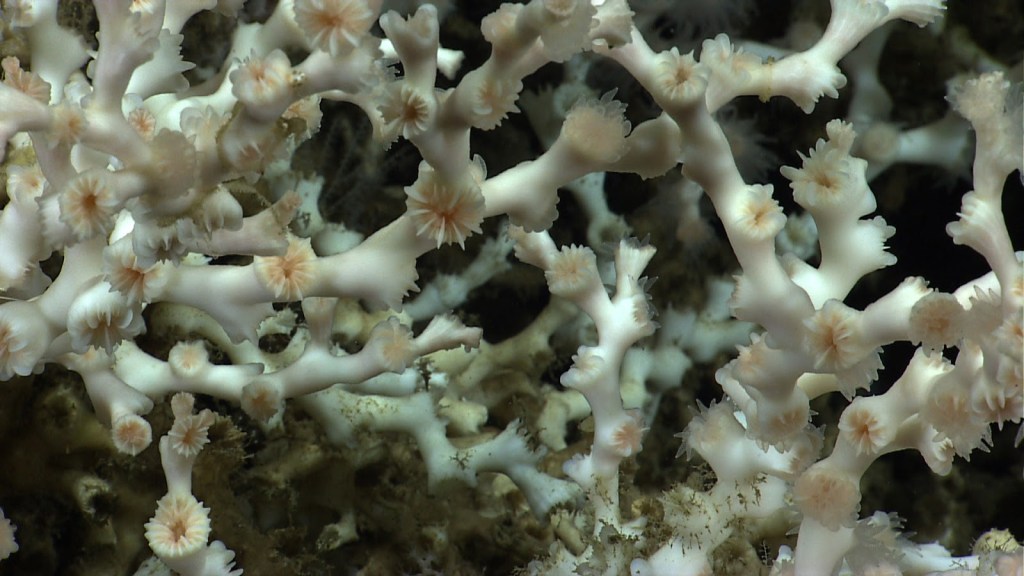
Some of the cold-water corals, referred to as hard corals, have a hard skeleton which gives them their shape and defines the structure of a reef. These are calcareous skeletons, whose growth and survival depend on the chemical balance in the water. They rely on specific water parameters, among which acidity.
Hard corals are often called “ecosystem engineers” because, through the development of their hard three-dimensional structures, they impact the environment creating a specific habitat for other organisms. They provide shelter to support other species; they act as nurseries for fish and feeding grounds, making them just as important as their tropical counterparts.
Similar to their relatives in the tropics, cold-water corals face some real threats and may even be more susceptible to them due to the specific environments they inhabit. Human activities such as trawling for fisheries impact deep-water coral reefs by destroying everything that comes their way. This is one of the main reasons for the observed decrease in numbers of cold-water corals.
A bigger challenge is posed by climate change. While tropical corals suffer the rise in sea temperatures, cold-water corals might be significantly damaged by another effect: ocean acidification. The oceans absorb a great deal of carbon dioxide (CO2) from the atmosphere, acting like a sponge. Waters are absorbing more due to our increased emissions, and are therefore becoming more acidic. Researchers J. Murray Roberts and Stephen Cairns highlight that the speed with which CO2 is released in the air and absorbed by the ocean has not been seen in over 20 million years.
The increase in absorption of CO2 by the oceans directly impacts this balance and threatens to dissolve corals’ skeletons. In a more dramatic expression: we are melting our corals away.
One way to try to preserve them is by creating marine protected areas to limit fisheries and therefore trawling. Regarding climate change, it is necessary to continue investigating its impact on these organisms to better understand how to prevent their collapse and the dreadful consequences that it has on ecosystems.
References:
Cadeira, K., & Wickett, M. E. (2003). Anthropogenic carbon and ocean pH. Oceanography, 435, 425–365.
Cairns, S. D. (2007). Deep-water Corals: an Overview with Special Reference to Diversity and Distribution of Deep-water Scleractinian Corals. In BULLETIN OF MARINE SCIENCE (Vol. 81, Issue 3).
Flögel, S., Dullo, W. C., Pfannkuche, O., Kiriakoulakis, K., & Rüggeberg, A. (2014). Geochemical and physical constraints for the occurrence of living cold-water corals. Deep-Sea Research Part II: Topical Studies in Oceanography, 99, 19–26. https://doi.org/10.1016/j.dsr2.2013.06.006
Roberts, J. M., & Cairns, S. D. (2014). Cold-water corals in a changing ocean. In Current Opinion in Environmental Sustainability (Vol. 7, pp. 118–126). https://doi.org/10.1016/j.cosust.2014.01.004
Roberts JM, Wheeler A, Freiwald A, Cairns S. Cold-Water Corals: The Biology and Geology of Deep-Sea Coral Habitats. Cambridge University Press; 2009.
 Reefbites