
Written by: Laura A. Gibson
The Great Barrier Reef (GBR) in Australia is considered one of the world’s greatest attractions. A mass coral bleaching event occurred in early 2024, which negatively affected a large number of corals at One Tree Reef, part of the Southern section of the GBR. After the latest heatwave, 53% of coral colonies tracked in this study were reduced to just fragments. Scientists from James Cook University in Queensland, Australia consider this to be a detrimental strike to one of the most important coral ecosystems in the world.
Parts of Western Australia have also been impacted by the warming ocean temperatures, causing the deaths of many fish, as well as the bleaching of coral across one region in particular (Kimberley). Single-celled algae called zooxanthellae live inside of coral and provide them with food and their beautiful colors. Coral bleaching is caused by imbalances in what coral needs to survive, including ocean water temperatures, sunlight levels, available nutrients, etc. When any of these are lacking, the zooxanthellae that allow the coral to live a happy and healthy life, die off and leave the coral white in color, and appear as just a mere skeleton. There is a chance of recovery in coral after bleaching, but without improvement in conditions and health, the coral can and will eventually die.
Maria Byrne and Michael Kingsford, along with several others, studied over 400 coral colonies near One Tree Island, in the southern section of the GBR, in 2024. This was done to determine the overall health of a large area of the reef after it had undergone a massive heatwave. This was the fifth time since 2016 that the area had seen a huge increase in coral bleaching.
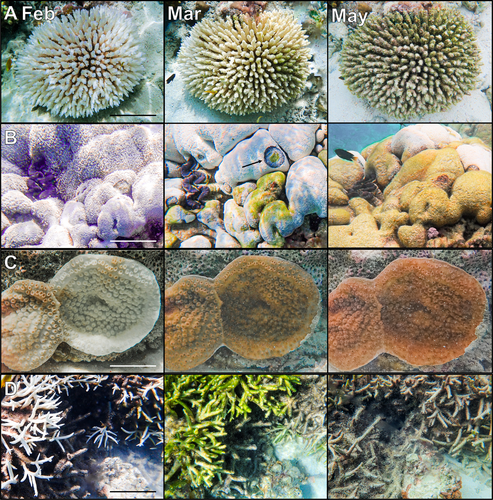
Figure 1: Time lapse of coral bleaching and death from February – May 2024. Photo credit: James Cook University Handout
During the study, Byrne et al. found that the heatwave had caused bleaching in two-thirds of the coral colonies by February 2024. Bleaching then increased to three-quarters by April 2024. Over half of the coral that had bleached was dead by July 2024. By the end of the summer months, 16% of the coral studied had recovered, while 31% was still bleached. Michael Kingsford, a Marine Biology professor at James Cook University, located in Australia, stated that large scale bleaching events were becoming more common to the Great Barrier Reef, and would most likely continue to occur every two years.

Figure 2: Coral bleaching surrounding One Tree Island in 2024 Photo credit: James Cook University Handout
This study brought new attention to the fight against global warming to stop it from destroying one of the world’s most beautiful attractions. Instead of being a potential threat to one of the most important ecosystems in the world, it is now here and happening much more often. Unfortunately, it is not only happening at the Great Barrier Reef, but all over the world – corals in the Pacific, Atlantic, and Caribbean have also been affected. On the Western side of Australia, scientists reported that more than 30,000 dead fish had washed up on the beach, which is also linked to increased ocean temperatures.

Figure 3: Examples of bleached and damaged coral colonies in the Great Barrier Reef in Australia. Photo Credit: James Cook University Handout
Although this study only focused on the continent of Australia, increased water temperatures have also affected many other coral reefs in the world, with some reaching up to five degrees warmer than normal conditions. Australia contains some of the strongest corals in the world that can withstand warmer temperatures than many other corals, but these ecosystems are still considered to be fragile. They are being tested now more than ever, and we need to act promptly if we want to limit the negative effects that will last for years to come.
References:
Association for the Sciences of Limnology and Oceanography (ASLO) Letter: Catastrophic bleaching in protected reefs of the Southern Great Barrier Reef
Catastrophic damage to reefs from ocean heatwaves
 Reefbites