
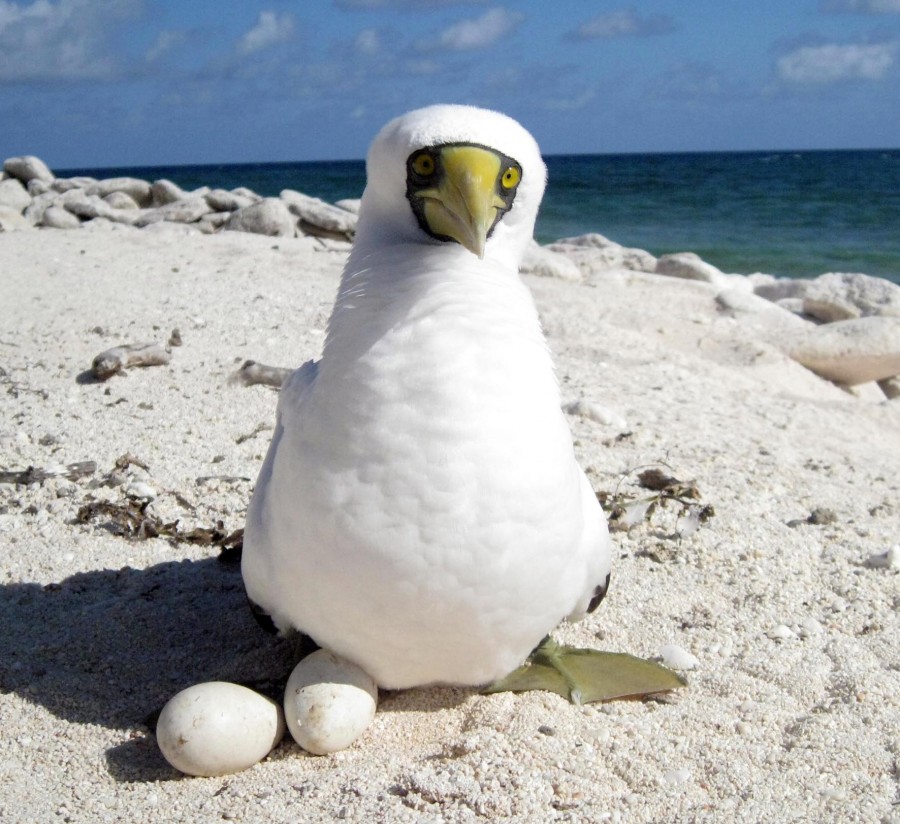
Image credit: https://eatlas.org.au/media/301, Daniella Ceccarelli
Written by: Jasmine Haskell
Edited by: Miranda Spencer Altice
Seabirds play a crucial role in the health of coral reef ecosystems, yet their contributions often go unnoticed. These avian superheroes add to the marine environment’s beauty and play a vital role in maintaining the ecosystem’s delicate balance. Seabirds, such as terns, noddies, boobies, frigatebirds, and shearwaters are known to forage in marine environments. They feed on marine organisms, such as fish and squid, and then return to their nesting colonies on islands. In their nesting colonies, seabirds deposit nutrient-rich guano, which contains high nitrogen levels and other essential nutrients. These nutrients are then leached into the surrounding ocean, providing a valuable food source for phytoplankton, forming the marine food web base. As the phytoplankton population thrives, it provides a steady food source for various organisms, including zooplankton, which are then consumed by filter-feeding corals and small fish. Furthermore, by preying on fish and invertebrates, seabirds help maintain a balance in the marine food web, preventing the overpopulation of species that can harm coral reefs (Signa et al., 2021).
Not only do seabirds contribute to the nutrient cycling and food web within coral reef ecosystems, but they also enhance the resilience of these fragile environments. A recent study by Benkwitt et al. (2023) found that seabird-derived nutrient subsidies can significantly boost the resilience of coral reefs following extreme events like marine heat waves. The study, conducted in the Indian Ocean, compared the recovery rates of reefs with and without seabird populations following a mass bleaching event in 2015-2016 by tracking stable isotope signatures and Acropora growth rates.
The results were striking – reefs adjacent to islands with seabird populations showed faster recovery time of Acropora coral cover and more dynamic recovery trajectories of entire benthic communities. The presence of seabirds was associated with a doubling of coral growth rates, both within individual corals and across entire reefs (Benkwitt et al., 2023). This suggests that restoring seabird populations and their associated nutrient pathways while simultaneously eradicating invasive rat populations could be a promising strategy for enhancing the resilience of coral reefs to climate change impacts. This research by Benkwitt et al. adds to previous studies on the influence of seabirds on the well-being of coral reefs by expanding on the effects of nutrient accumulation following a widespread bleaching event.
Despite their significant role in coral reef health, seabird populations are facing various threats such as habitat destruction, overfishing, predation by rats and pollution. Conservation efforts are crucial to ensuring these unsung heroes’ continued presence and positive impact in coral reef recovery. Understanding the intricate relationships between seabirds and coral reef ecosystems is crucial for their conservation and the overall health of these diverse habitats. Consequently, efforts to protect and restore seabird populations can have far-reaching positive effects on the resilience and recovery of coral reefs in the face of inevitable future environmental challenges.
References
Benkwitt, C E., D’Angelo, C., Dunn, R E., Gunn, R L., Healing, S., Mardones, M L., Wiedenmann, J., Wilson, S K., & Graham, N A J. (2023, December 8). Seabirds boost coral reef resilience. https://doi.org/10.1126/sciadv.adj0390
Signa, G., Mazzola, A., & Vizzini, S. (2021, March 1). Seabird influence on ecological processes in coastal marine ecosystems: An overlooked role? A critical review. https://doi.org/10.1016/j.ecss.2020.107164
 Reefbites