
Written by: Caleb Butler
Family Symbiodiniaceae: often referred to as the unit of coral bleaching, this group comprises various genera of algal symbionts that associate with corals and numerous other invertebrate groups. The phenomenon of coral bleaching is defined by the loss of these crucial endosymbionts. While research of this group has made significant progress in recent decades, it could not have been done without Sister Mary Dolores Ahles, an unsung hero who played a pivotal role in culturing these organisms and developing one of the most widely used culture medias: ASP-8A.

[Fig 1. An electron microscope image of two Symbiodinium pilosum, a symbiont closely related to S. microadriaticum, the organism Sister Dolores devoted her dissertation to understanding. Panel A displays the motile “mastigote” stage with its (two) flagella that make it motile. Panel B displays the more sedentary “coccoid” stage where it lacks the flagella. Images graciously provided by Dr. Hae Jin Jeong and Dr. Sung Yeon Lee from the Seoul National University.]
Born in 1912 to a pair of farmers in Verndale, Minnesota, Sister Dolores was one of six daughters. In her academic journey, she earned a Bachelor of Arts from the College of St. Benedict, St. Joseph and taught secondary school in central Minnesota for several years. In 1950, she was awarded a Master’s of Science degree from Marquette University, Milwaukee, and in 1967, she earned her Doctorate of Philosophy in Microbiology from Fordham University under the guidance of her doctoral advisor, John J. A. McLaughlin.
Sister Dolores’ dissertation, titled “Some Aspects of the Morphology and Physiology of Symbiodinium microadriaticum”, delves into the history of the study of Symbiodiniaceae, offering insight into the past, when scientists believed that these endosymbionts (symbionts inside the host’s cells) were parasitic or gametes of the host corals, to the modern understanding of coral and symbiotic partner living in a mutual relationship where both partners benefit. In her dissertation, Sister Dolores focuseds on observing Symbiodinium microadriaticum within and outside of its host, the upside-down jellyfish (Figure 2., Cassiopea), documenting morphological stages between the dinoflagellate’s motile and coccoid forms (Figure 1), and conducting one of the first thermal stress and nutrient limitation experiments of cultured Symbiodiniaceae.
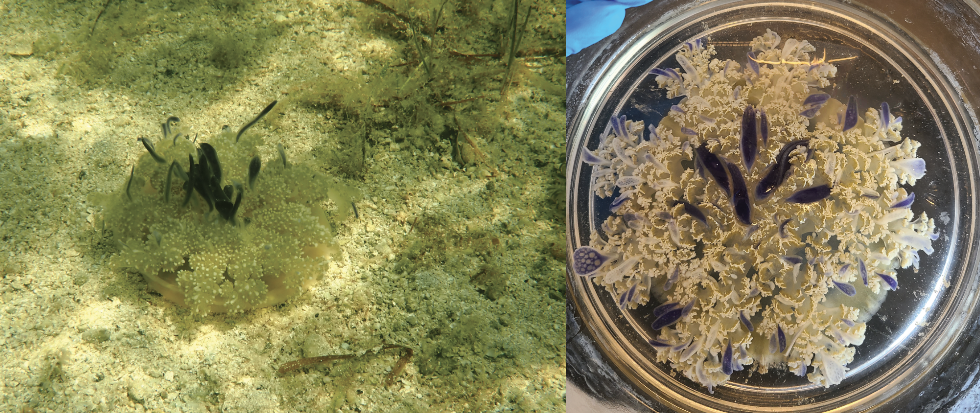
[Fig 2. An image of the Upside-Down Jellyfish, Cassiopea. The symbiotic algae of family Symbiodiniaceae can be found in its tentacles that face upwards towards the sun. The image on the left shows the jellyfish in its natural, mangrove habitat, while the image on the right shows the jellyfish in a petri dish with its tentacles and arms facing upwards. Image graciously provided by Victoria Sharp and Vivian Li from the Medina Lab at Penn State University.]
Yet, one of Sister Dolores’ biggest contribution to the field was in her methods, not the results. Prior to her work, her advisor, John J. A. McLaughlin was involved in creating the growth media ASP-2. However, Sister Dolores, realizing the need for further modification for her research purposes, developed the media ASP-8A, one of the most widely used culturing media for Symbiodiniaceae, alongside F/2. Today, this media is used by researchers globally studying these algal symbionts, but very few recognize the name behind its creation.
Apart from her published dissertation, there is very little more we can gleam from who she was as a person. Sister Dolores was an avid reader and published several book reviews in the journal *The American Biology Teacher* from 1976-1986, funnily enough, citing a displeasure with terminology rich literature, but still a keen interest in science and science education, even in her later years. An article from the St. Cloud Times in Minnesota indicates that Sister Dolores retired in 1987 from the sciences to work in St. John’s Convent with two of her other biological sisters (that were also Franciscan nuns, like Sister Dolores). Records indicate that Sister Dolores passed away on December 14th, 1995.
Today, many researchers still use the media that Sister Dolores created and coined in her dissertation in 1967 for isolating new Symbiodiniaceae cultures from the field (Gong et al. 2019), conducting experiments (Turnham et al. 2023), and it is even being used for non-Symbiodiniaceae systems, such as with a recently discovered green alga known as Symbiochlorum hainanensis isolated from bleached corals in the South China Sea (Gong et al. 2018). In celebrating the legacy of Sister Mary Dolores Ahles, Ph.D., we acknowledge the profound impact her work has had on our understanding of Symbiodiniaceae and the organisms they associate with. Her dedication to the cultivation of these vital organisms and the creation of ASP-8A, a cornerstone in the field of culture work, continues to resonate in laboratories worldwide.

[Fig 3. Sister Dolores Ahles, pictured in the bottom center, with her two biological sisters, Sister Mary Theophane Ahles and Sister Mary Lucina Ahles (left and right respectively), with Sister Cleone Renner in the rear center.]
References:
Ahles, O. S. F., Sister Mary Dolores (1967) Some Aspects of the Morphology and Physiology of Symbiodinium microadriaticum. Dissertation. Fordham University.
LaJeunesse, T. C. (2017) Validation and description of Symbiodinium microadriaticum, the type species of Symbiodinium (Dinophyta). Journal of Phycology. https://doi.org/10.1111/jpy.12570
Ahles, O. S. F., Sister Mary Dolores (1986). Review: Photosynthesis by Christine H. Foyer. The American Biology Teacher. https://doi.org/10.2307/4448229
Gong, S., Xu, L., Yu, K., Zhang, F., Li, Z. (2019). Differences in Symbiodiniaceae communities and photosynthesis following thermal bleaching of massive corals in the northern part of the South China Sea. Marine Pollution Bulletin. https://doi.org/10.1016/j.marpolbul.2019.04.069
Turnham, K. E. (2023). On the Ecology and Evolution of Symbiotic Dinoflagellates. Dissertation. Penn State.
Gong, S., Li, Z., Zhang, F., Xiao, Y., Cheng, H. (2018). Symbiochlorum hainanensis gen. et sp. nov. (Ulvophyceae, Chlorophyta) isolated from bleached corals living in the South China Sea. Journal of Phycology. https://doi.org/10.1111/jpy.12779
 Reefbites