

Written by: Rebecca Campbell Gibbel, DVM
Seeing in color is important for reef creatures whether it is to understand information for reproduction and territorial protection displays or for changing the color of their bodies to camouflage themselves and escape predators.
Color vision in many marine species is similar to humans’, with the familiar rods and cones of the eyes responsible for sight. But other aquatic species have color vision that is perplexing and raises questions about whether “color-blind” animals like octopuses and squid can see color and how they do it. The color vision of mantis shrimp is also puzzling, since they possess four times as many visual color receptors as humans do, yet only have mediocre color vision. Researchers are investigating these questions and have proposed some intriguing explanations.
Marine organisms have spent millions of years evolving sensory systems that can be wildly different from terrestrial animals. The visual skills of cephalopods (like octopuses, squid, cuttlefish, and chambered nautiluses) and mantis shrimp are excellent examples of this concept.

The unusual shapes of cephalopod pupils are adapted to maximize their vision.
Cephalopods have long been considered color blind since their retinas only have one light-sensing pigment molecule or opsin, which detects dark or light. This is in contrast to the three photoreceptors in the cones of human retinas that allow us to see red, green, blue, and their many combinations. It has been an enigma that many cephalopods whose eyes were thought to only register shades of gray, are able to create dazzling displays of color in their skin to signal to others and to perfectly color-match themselves to their environment for camouflage.
In contrast to these single receptor animals is the mantis shrimp, whose 450 species are the superstars of the visual sensory world. Some mantis species have an incredible 14 photoreceptors! Though mantis shrimp have 12 receptors for color vision, they do not see four times more colors than humans do, and they probably see the same color spectrum that we do- just in a vastly different way.
Mantis shrimp also have a receptor for UV vision, and are the only known animals that can sense circularly polarized light. Scientists think that this receptor may allow these shrimp to signal to each other in a way that no other creatures can see– like a secret code you make up with your friends!
So how do these amazing creatures sense color? We can start by diving into the astonishing world of octopus and cuttlefish vision. In a paper by Stubbs and Stubbs (2014), the authors studied octopuses’ eyes, and proposed a complex optical model called chromatic aberration, to explain how octopuses’ eyes process color. Cephalopods’ eyes may detect color by separating the wavelengths of light, which provides color vision without the photopigments that exist in the eyes of other animals. The model proposes that cephalopods’ horizontal pupils function as a prism, splitting white light into its colored wavelengths, which land individually on different areas of the retina. Chromatic aberration, or blur, is the reaction that occurs when an octopus changes the depth of its eye and sweeps through focus by changing the pupil to retina distance. This is like the temporary blur that happens when you zoom in to take a photo. This action creates a varied haziness of the image, and can be used to deduce color, since different wavelengths come into focus at different intraocular distances.

The photo above shows the blue-ringed octopus of the genus Hapalochlaena, which also has iridophore pigment cells to make their colors glitter!
Light-sensing opsin molecules are found in octopus’ eyes and also in their skin within the pigment-containing cells, or chromatophores. Chromatophores allow an octopus’s skin to rapidly change color, either to stand out and signal information, or to blend in and match the background color configuration. Pigment granules inside the chromatophore cells can disperse or concentrate under the control of nerve fibers, which is a process that enables exquisite fine tuning of skin patterns and colors. The opsins that are present in the skin may mean that octopuses can detect light and even color without using their eyes!
MANTIS SHRIMP: OPTICAL SUPERSTARS
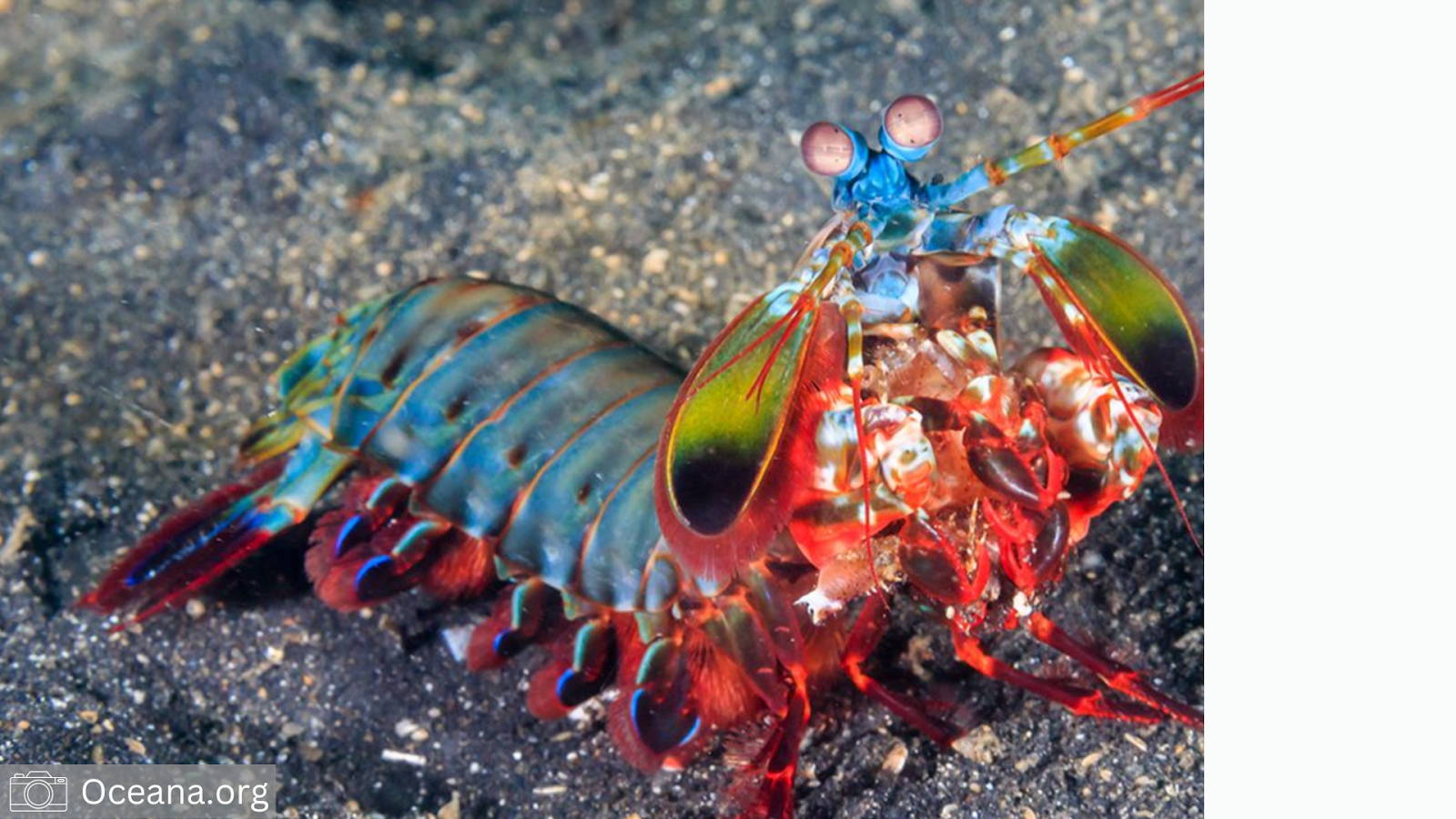
The mantis shrimp is the visual celebrity of the reef, with some species possessing 14 photoreceptors providing truly technicolor vision. The fanciest member of the group is the peacock mantis shrimp (Odontodactylus scyllarus) shown above, which is decked out year-round in Mardi Gras attire. Seeing such a marvelous costume must be overwhelming when viewed with 14 photoreceptors! It seems that these animals should be able to see a multitude of novel colors that humans cannot perceive. But although mantis shrimp can see polarized and ultraviolet light, they probably do not see a sea of colors. Instead, they have evolved a completely novel way of visualizing the world.
HUMAN COLOR VISION:
Although people cannot detect ultraviolet or polarized light, we can see thousands of hues using a precise form of vision called color discrimination, which uses nerve impulses to compare and code similar colors. Although we have just three photoreceptors to see colored light, humans are extremely good at distinguishing thousands of colors, though our method requires a lot of brain processing to accomplish this feat. For our species, seeing requires the visual receptor of our retina to collect a two-dimensional image, and a complex brain to compute and interpret what is being seen.
SHRIMP SCANNERS:
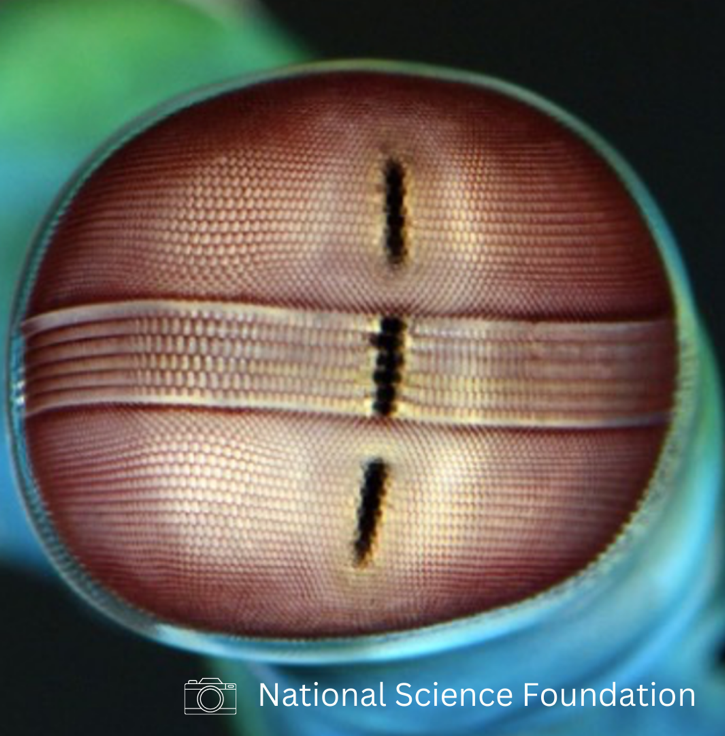
The eye of a peacock mantis shrimp (Odontodactylus scyllarus) is composed of a dorsal and ventral hemisphere, and central mid-band with color vision receptors.
Mantis shrimp have eyes on stalks which can move independently in all directions. They have a compound eye structure similar to the eye of a bee or fly, which has an array of 10,000 tiny visual units. Different parts of their eyes are used for detecting color, polarized light, and ultraviolet light. They move their eyes back and forth to scan an image across the horizontal arrays, in a manner similar to a supermarket bar code reader.
Research by Thoen et al., (2014) proposed that this ocular scanning helps the mantis shrimp recognize specific hues, and the authors performed electrophysiological experiments which demonstrated that a different color is assigned to each one of the shrimp’s receptor types. They trained Haptosquilla trispinosa mantis shrimp to choose between different colored wands for food rewards and found that the shrimp had surprisingly poor performance in discriminating closely related colors, at least in comparison to humans. Although their scanning color recognition approach is less sensitive than the system that people use, it allows immediate identification of particular colors, and does not require intensive brain processing. This is advantageous for a predatory crustacean that relies on speed to locate prey of specific colors.

The figure above from Thoen et al., (2014) shows how the mantis shrimp’s photoreceptor cell types are thought to each sample a narrow set of wavelengths, covering the color spectrum from 300 to 720 nanometers, or ultraviolet to deep red.
BEAUTY IS IN THE EYE OF THE BEHOLDER:
Both the cephalopods and the stomatopods have developed radically different ways of seeing their worlds, and researchers are beginning to understand the remarkable nature of their vision. The habitat complexity of reefs gives rise to numerous ecological niches that allow such divergent evolutionary pathways. But with the biodiversity of reefs disappearing rapidly under the effects of climate change and other anthropogenic influences, it is important to learn more about reef inhabitants like this before their secrets are lost.
REFERENCES:
Bok, M. J., Roberts, N. W., & Cronin, T. W. (2018). Behavioural evidence for polychromatic ultraviolet sensitivity in mantis shrimp. Proceedings. Biological sciences, 285(1884), 20181384. https://doi.org/10.1098/rspb.2018.1384
Daly, I. M., How, M. J., Partridge, J. C., Temple, S. E., Marshall, N. J., Cronin, T. W., & Roberts, N. W. (2016). Dynamic polarization vision in mantis shrimps. Nature Communications, 7. https://doi.org/10.1038/ncomms12140
Morrison, J. (2014). Mantis shrimp’s super colour vision debunked. Nature News.
Stubbs, A. L., & Stubbs, C. W. (2016). Spectral discrimination in color blind animals via chromatic aberration and pupil shape. Proceedings of the National Academy of Sciences of the United States of America, 113(29), 8206–8211. https://doi.org/10.1073/pnas.1524578113
Thoen, H. H., How, M. J., Chiou, T. H., & Marshall, J. (2014). A different form of color vision in mantis shrimp. Science, 343(6169), 411–413. https://doi.org/10.1126/science.1245824
 Reefbites