
Rebecca Campbell Gibbel, DVM
Red corals have been collected by humans for over 2000 years and are prized for their lustrous red or pink hue after polishing. Even in our modern world, red corals are still worn in some cultures to protect against evil spirits and misfortune. Although there are 31 species of red corals, most of the harvest for the jewelry trade consists of the vibrant red Corallium rubrum and Corallium japonicum, which have similar coloration. They are known as “red gold”.
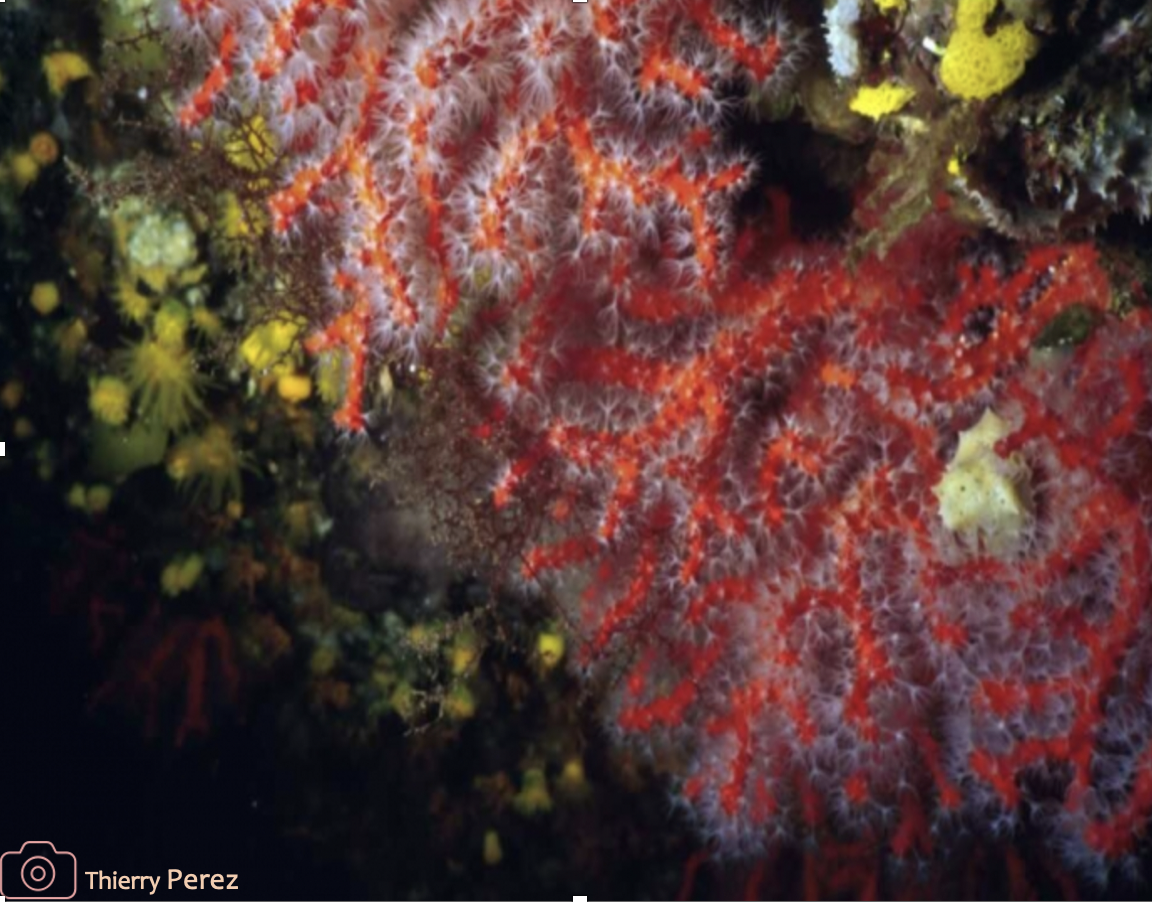

Corallium rubrum (top) and Corallium japonicum (bottom) are the species of red coral most commonly harvested.


Jewelry made from harvested red corals.
In addition to their beauty, red corals have some special adaptations that set them far apart from their tropical reef cousins. Previously, they were plentiful in the Mediterranean and along the coasts of Japan, Taiwan, Malaysia, and northeast Australia. In past decades, red corals grew as large as trees, and their assemblages were known as the underwater forests of the Mediterranean. These colonial animals can live to 200 years of age and mature slowly, which makes them vulnerable when harvesting is not controlled. Unfortunately, over-exploitation in shallow waters has removed all large colonies and has caused local extinction in some areas, causing Corallium rubrum to be on the International Union for Conservation of Nature’s Red List of Threatened Species.
Like tropical reef corals, the temperate red corals have also been adversely affected by the effects of climate change- with ocean warming and acidification (Cerrano et al., 2013) causing increasing threats to their survival.
Although both reef corals and red corals share a discouraging story of decline due to numerous impacts of human origin, red corals have several advantages that may offer hope and allow them to persist much longer in our changing oceans.
Going it alone: life without symbiotic microalgae
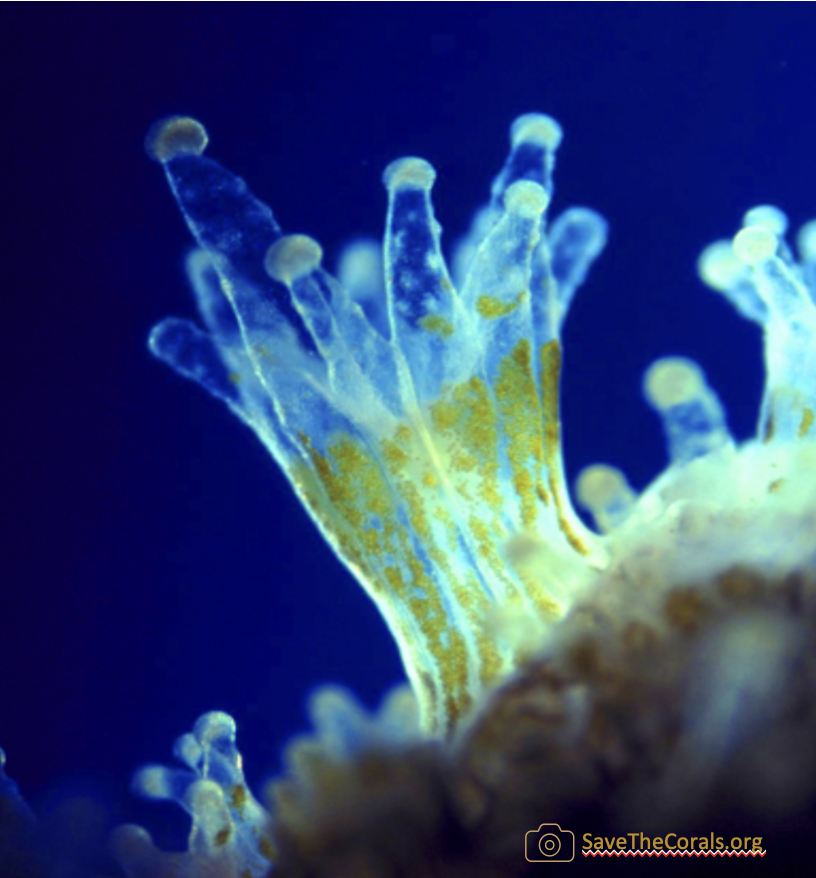
Almost all tropical reef corals harbor Symbiodiniaceae, which are the tiny golden-brown symbiotic algae that live within the bodies of the coral polyps. These microalgae provide essential nutrition to the corals, and they require clear well-lit waters to allow photosynthesis. This means that corals that depend on Symbiodiniaceae are obligated to live in shallow depths with lots of sunlight.
This symbiosis has allowed tropical corals to thrive for millennia, but with global warming, the shallow waters under 60 meters are generally becoming too warm for these photosynthetic corals.
In contrast, red corals do not host symbiotic microalgae and they derive their food from floating plankton. This allows them to benefit from the cooler dark habitat of the deep ocean, as they have been found at depths over 800 feet.
Red corals were previously harvested by humans using trawler nets that scrape the ocean bottom, causing immense damage to reefs. However, the ability to live in caves and rocky crevices allowed some red corals to evade trawling nets. Now that trawling has been banned in most Mediterranean countries and collection is prohibited at depths under 50 meters, red coral populations in marine protected areas have increased. Unfortunately, illegal harvesting is rampant, and red coral’s origin cannot be traced. Organized crime has become involved in its distribution, compounding the high level of illegal, unreported, and unregulated catches.
Shape shifting, aka Phenotypic plasticity

In times of stress due to elevated temperatures and low dissolved oxygen, red corals have been found to adopt a smaller size profile. This is not just a result of larger colonies being removed, but rather a strategy the corals use since having a smaller body size requires fewer nutrients. This creates a tradeoff for the corals: with a diminished size, the corals may survive in compromised conditions, but their reproductive fitness is reduced- with lower larval production and diminished settlement of juvenile corals. Size reduction may be successful in the short term, but as a long-term strategy, a restricted size may not be sustainable.
How do corals possibly resize themselves? Red corals use a strategy of autotomy, which is a process in which the coral dissolves portions of itself. Researchers have followed individual red coral colonies in times of thermal or salinity stress and found that surviving corals diminish their own size by self-detaching the ends of their branches. The separated ends don’t tend to regrow into new corals, so this is probably not a reproductive strategy but rather a survival technique to conserve resources (Roveta et al., 2023).
A little help from their friends

Like all corals, red corals possess a surface microbiome consisting of many different bacterial strains that have protective functions to help ward off infections and to resist the effects of marine heat stress. The normal environmental temperature for red corals in deep water habitats is 15°C. However, experiments found that the microbiome of deep-water red corals remains surprisingly functionally intact in elevated sea temperatures of 21 °C. This provides promising evidence that these corals are likely to persist under the increased temperatures that are estimated to occur at the end of this century (Tignat-Perrier et al., 2023.)
In conclusion: the end is nigh
Scientists predict that in the next 30 to 50 years, coral reefs across the globe will become extinct, but their projections vary depending on the rate of global warming. If humanity does not protect corals from habitat degradation and overharvesting, and is unwilling to contain carbon emissions that cause the ocean to acidify, 90% of corals could vanish in a mere 20 years.
Although the deeper ocean and its inhabitants will also heat up as climate change marches on, red corals’ adaptations may mean that they could be the last coral survivors, and truly merit the name “red gold.”
————————————————————
WORKS CITED:
Cerrano, C., Cardini, U., Bianchelli, S., Corinaldesi, C., Pusceddu, A., & Danovaro, R. (2013). Red coral extinction risk enhanced by ocean acidification. https://doi.org/10.1038/srep01457
Roveta, C., Pulido Mantas, T., Bierwirth, J., Calcinai, B., Coppari, M., di Camillo, C. G., Puce, S., Villechanoux, J., & Cerrano, C. (2023). Can colony resizing represent a strategy for octocorals to face climate warming? The case of the precious red coral Corallium rubrum. Coral Reefs, 42(2), 535–549. https://doi.org/10.1007/s00338-023-02365-9
Tignat-Perrier, R., van de Water, J. A. J. M., Allemand, D., & Ferrier-Pagès, C. (2023). Holobiont responses of mesophotic precious red coral Corallium rubrum to thermal anomalies. Environmental Microbiome, 18(1). https://doi.org/10.1186/s40793-023-00525-6
BACKGROUND:
Cau, A., Bramanti, L., Cannas, R., Moccia, D., Padedda, B. M., Porcu, C., Sacco, F., & Follesa, M. C. (2018). Differential response to thermal stress of shallow and deep dwelling colonies of mediterranean red coral corallium rubrum (L., 1758). Advances in Oceanography and Limnology, 9(1), 13–18. https://doi.org/10.4081/aiol.2018.7275
Galopim, Rui de Carvalho. (Spring 2019). Breaking down the Misunderstandings about Precious Coral. Gems & Jewellery, The Gemmological Association of Great Britain.
Haguenauer, A., Zuberer, F., Ledoux, J. B., & Aurelle, D. (2013). Adaptive abilities of the Mediterranean red coral Corallium rubrum in a heterogeneous and changing environment: from population to functional genetics. Journal of Experimental Marine Biology and Ecology, 449, 349–357. https://doi.org/10.1016/J.JEMBE.2013.10.010
Scholz, J. (2023, April 03). “The Secretive Red Coral Trade in the Mediterranean Sea- the hunt for red gold”: Earth Journalism.net. https:// https://earthjournalism.net/stories/the-secretive-red-coral-trade-in-the-mediterranean-sea-the-hunt-for-red-gold
 Reefbites